
This is Part 6 of The AI Reckoning: A Future of Trust Series
For most of human history, the challenge was finding enough information to make a good decision.
Today the challenge is surviving the tsunami.
Every morning brings another model, another benchmark, another study, another prediction, another expert explaining where AI is taking us next. Articles are summarized before we’ve read them. Research is synthesized before we’ve had time to consider it. Opinions arrive polished, confident, and increasingly difficult to distinguish from one another. Artificial intelligence has compressed the distance between questions and answers so dramatically that information is no longer our constraint.
Discernment is.
Somewhere inside this torrent are extraordinary insights. There is also speculation, marketing, repetition, bias, and enough convincing language to support almost any conclusion we want to reach. The challenge is no longer access to knowledge. It is deciding what deserves our attention, what deserves our skepticism, and what deserves the patience of a second look. That feels like a very different kind of leadership challenge than the ones we’ve spent the last two decades preparing for.
Every technological revolution changes the muscles society exercises. Calculators reduced the need for mental arithmetic. GPS changed how we navigate and remember geography. Search engines shifted our relationship with memory itself, replacing recall with retrieval. None of those technologies made us less capable. They changed where we invested our cognitive effort.
I find myself wondering whether AI is doing something similar with judgment. Not replacing it. Changing how often we exercise it.
Judgment has always been one of our defining human capabilities. I suspect we’re entering an era where it must become a deliberate discipline rather than an unconscious habit. The more information arrives at machine speed, the more valuable it becomes to slow down long enough to ask whether we’re seeing signal or simply responding to whatever demanded our attention first.
That thought finally crystallized for me during a demo day a couple of years ago. The founder before the break began with his previous company. It had been acquired by a name everyone in the room recognized, for a number everyone repeated to each other over coffee. He hadn’t said a word about the company he was pitching that afternoon, yet the room was already leaning forward. The questions afterward were warm, almost collegial.
Very few people asked what the business depended on, how resilient the architecture was, or what would happen if the market beneath it changed.
The founder who followed couldn’t tell that story. She spoke instead about customer retention, infrastructure decisions, and the choices she had made to avoid becoming dependent on a single platform. Her product solved one decidedly unglamorous problem, but it solved it completely. The questions she received were shorter, more skeptical, and noticeably less generous.
If I were placing a bet today, I would choose her company every time.
I’ve replayed that afternoon more often than I expected because it revealed something I now recognize almost everywhere. We have become remarkably efficient at evaluating the signals that are easiest to see, and surprisingly inconsistent at recognizing the ones most likely to predict whether something will endure. Under pressure, the impressive résumé often outweighs the resilient architecture. The polished demonstration eclipses the thoughtful design decision. Familiarity quietly becomes a substitute for judgment.
The challenge is no longer access to knowledge. It is deciding what deserves our attention, what deserves our skepticism, and what deserves the patience of a second look.
As I’ve written this series, something unexpected has happened. Each article began by exploring a different challenge surrounding AI: the infrastructure, the economics, the platforms, the fragmentation, the human adoption gap.
Yet after each one, I found myself coming back to the same question. We have more information than any generation before us. Why does good judgment sometimes feel harder rather than easier? I don’t think technology created that problem. I think it revealed it.
The Discipline of Judgment
Over the last year, I’ve noticed something changing in myself.
I trust my first reaction less than I used to, and it’s not because I’ve become more skeptical. In fact, quite the opposite. I still find myself excited by what AI is making possible. But I’ve also become aware of how easily certainty can now be manufactured. Every day brings another remarkable demonstration, another confident prediction, another analysis that feels complete before I’ve had time to consider whether it’s actually true.
I’ve realized the challenge is no longer finding answers. It’s deciding which answers deserve my trust and that feels like a different kind of work than I was doing even a few years ago. For most of my career, good judgment meant gathering enough information before making an important decision. Increasingly, I find myself doing the opposite. I spend less time looking for additional information and more time deciding what deserves my attention in the first place. Information has become abundant. Attention has not.
I don’t think I’m alone.
When we say we trust someone’s judgment, we’re rarely talking about intelligence. We all know brilliant people whose decisions we wouldn’t follow. We also know quieter leaders whose advice somehow carries unusual weight, and it’s not because they always have the answer. It’s because they’ve developed the habit of seeing one layer deeper than everyone else.
We have become remarkably efficient at evaluating the signals that are easiest to see, and surprisingly inconsistent at recognizing the ones most likely to predict whether something will endure.
Perhaps that’s what discernment really is. Not judgment itself, but the practice that comes before judgment. The willingness to pause, to doubt, and to ask one more question before accepting the first convincing answer.
I’ve spent much of my career helping leaders navigate uncertainty, and I’ve come to believe trust follows good judgment far more often than confidence. Confidence persuades. Discernment earns trust. AI hasn’t diminished the importance of judgment, rather it has magnified it. The easier answers become to produce, the more valuable it becomes to recognize which ones deserve our attention and trust.
Sometimes I wonder whether judgment is like any other human ability. The capabilities we practice become stronger, while the ones we quietly outsource begin to fade. Calculators didn’t make us incapable of arithmetic, but most of us no longer calculate in our heads. GPS changed how often we rely on our own sense of direction. Search engines reshaped what we remember because retrieval became easier than recall.
I don’t know yet what AI will do to judgment.
I do know it’s worth asking before we stop exercising it.
The Shortcuts We Reward
Last year the word slop entered the mainstream. Officially, it describes low-quality content produced at extraordinary scale through generative AI. The definition is accurate, but I’ve come to think it captures only the smallest expression of a much larger pattern. Content was simply where we noticed it first.
Confidence persuades. Discernment earns trust.
AI hasn’t diminished the importance of judgment, rather it has magnified it.
The same dynamic now appears almost everywhere decisions are made quickly. Product demonstrations optimized for attention rather than resilience. Strategy decks polished enough to survive the board meeting but unable to survive implementation. Procurement processes that reward feature lists before understanding workflow. Investment decisions influenced by familiarity because familiarity is easier to evaluate than architecture.
The common thread isn’t artificial intelligence. It’s our growing tendency to reward whatever performs well during the first evaluation instead of asking whether it will still hold up during the second. AI didn’t create that instinct. It simply accelerated the consequences.
The Builder’s Dilemma
Imagine a founder we’ll call Jordan.
Jordan is talented, deeply technical, and building at a pace that would have seemed impossible only a few years ago. What once required an engineering team and months of development can now be accomplished in a long weekend with the right combination of models, tools, and determination. That is one of the genuine marvels of this moment. The barriers separating imagination from execution have fallen farther and faster than almost anyone predicted.
Technology changed, and markets changed with it. The signals that attract attention changed as well.
Jordan discovers very quickly that architectural resilience rarely earns the first meeting. Platform independence doesn’t generate headlines. A carefully considered approach to long-term maintainability isn’t what gets shared on social media or featured in product launches. Attention follows novelty. Investment follows momentum. Recognition follows whatever appears to be moving fastest.
None of that makes anyone irrational. Jordan gets it. Markets reward what they can evaluate quickly, and speed has become one of the easiest things to recognize. So he adapts.
The product demonstration becomes a little more polished. The roadmap stretches a little further into the future than the engineering team would privately promise. Questions about infrastructure become conversations for another meeting. Human adoption becomes something to solve after product-market fit.
One compromise is rarely significant. Thousands of similar compromises begin to shape an entire ecosystem.
I’ve come to believe that many founders aren’t optimizing for durability nearly as much as they’re optimizing for investability. They’re responding rationally to the incentives placed in front of them. When the market consistently rewards what looks finished, it shouldn’t surprise us that so much effort goes into appearing finished, because every system eventually produces the behavior it rewards.
That observation extends well beyond founders.
When Familiar Feels True
Investors like to believe they recognize exceptional companies, and they often do. Experience matters. Pattern recognition matters. The ability to quickly identify talent is one of the reasons successful investors become successful in the first place.
Experience, however, has a quiet companion. Familiarity.
Behavioral researchers have spent decades documenting how uncertainty changes the way people make decisions. As ambiguity increases, the human brain begins searching for anchors. Something recognizable. Something that resembles a previous success. Something that reduces the discomfort of not knowing. Pedigree becomes reassuring. A familiar logo. A prestigious university. A previous exit.
Even physical resemblance has been shown to influence investment decisions more than most people would like to admit. Research from UCLA found that investors expressed greater interest in founders whose faces subtly reminded them of their own, particularly when objective information about the company was limited.[i]
When the market consistently rewards what looks finished, it shouldn’t surprise us that so much effort goes into appearing finished, because every system eventually produces the behavior it rewards.
None of this reflects dishonesty. It reflects humanity and we can even say biology. Our primitive brains see familiar as safe, and under pressure and overwhelm familiarity begins masquerading as evidence.
That distinction feels increasingly important in today’s AI market because uncertainty has never been higher. Nearly every company can produce an impressive demonstration. Every week introduces another breakthrough, another valuation, another announcement that seems to redefine the competitive landscape all over again.
When everything looks extraordinary, extraordinary stops being a reliable signal. The temptation is to lean more heavily on whatever still feels familiar, but ironically, those may be the very moments that require us to do the opposite.
The slower questions rarely generate excitement. They generate clarity. How dependent is this business on infrastructure it doesn’t control? What assumptions have to remain true for this model to work three years from now? What happens if those assumptions change?
Those questions are less satisfying than a compelling founder story. And they are also remarkably difficult to answer quickly.
Perhaps that’s exactly why they deserve more attention.
The Quiet Cost of Fast Decisions
Enterprise leaders face the same challenge from a different direction. The pressure is to avoid becoming the company that moved too slowly. Every board meeting now contains some version of the same conversation. Competitors are adopting AI. Customers expect it. Analysts are talking about it. Employees are experimenting with it whether policy allows it or not. Waiting feels risky. Moving quickly feels responsible.
Yet speed has a way of changing the questions we ask. The demonstration becomes more important than the deployment. Capabilities become easier to compare than outcomes. The procurement conversation revolves around features, while the more consequential questions remain surprisingly quiet. Will people actually choose to use this once the rollout is over? Does it reduce complexity or simply relocate it? Will this still fit the way our organization works six months from now, after the excitement has faded and the novelty has worn off? Those questions rarely appear in product demonstrations. They reveal themselves only after implementation begins.
When everything looks extraordinary, extraordinary stops being a reliable signal.
Stanford and BetterUp recently described one consequence of this dynamic with a term that immediately resonated with me: workslop. Their research found that AI-generated work often appears complete while quietly increasing the amount of effort required by everyone downstream.[ii] Documents become longer but less thoughtful. Summaries require verification. Emails sound polished while communicating remarkably little. Employees spend time deciphering work that initially appeared finished.
The cost isn’t simply productivity. It’s confidence. Close to half of employees who received this kind of work said it made them see the sender as less capable, less creative, and less reliable. Forty-two percent said it made them trust that person less. Nearly a third said they’d be less willing to work with them again.[iii] Trust erodes in ordinary ways: a manager quietly starts double-checking someone’s work, a colleague grows hesitant to collaborate after one draft required too much rewriting. An employee who adopted AI hoping to appear more productive unintentionally becomes perceived as less careful, less creative, or less reliable.
The researchers were careful to point out that this wasn’t laziness. It was largely the predictable outcome of organizations encouraging greater AI adoption without investing equal effort in helping people use it well. That observation stayed with me because it echoes a pattern we’ve seen throughout this series.
Technology rarely creates the deepest problems. It exposes the assumptions we were already making.
What Signal Actually Looks Like
Noise has one remarkable advantage. It announces itself. Signal rarely does. It usually arrives quietly, without urgency or spectacle, asking questions that feel almost disappointingly ordinary.
Builders often recognize signal in the decisions no customer will ever notice. Architecture. Dependencies. Maintainability. The work that never appears in a product announcement but quietly determines whether a company can survive its second and third chapters.
Investors find signal in different places. Not in the certainty of a forecast, but in the quality of the assumptions beneath it. They ask what happens if the model provider changes direction, if infrastructure costs rise faster than expected, or if the competitive landscape looks entirely different eighteen months from now. The companies worth backing are rarely the ones with all the answers. More often, they’re the ones asking the most thoughtful questions.
Technology rarely creates the deepest problems. It exposes the assumptions we were already making.
Enterprise leaders face perhaps the most practical version of all. Product demonstrations eventually end. Adoption begins the following Monday morning. Will people still choose this tool after the rollout? Has it reduced complexity or simply relocated it? Does it disappear into the work, or does the work begin revolving around it? Those questions are quieter than feature comparisons. They are also far better predictors of whether technology becomes capability or simply another expense.
I’ve noticed something else while writing this series. The signals that matter most almost always require patience. The market rewards speed. Signal rewards attention. Those aren’t the same investment.
One Debt. Three Ledgers.
Looking across builders, investors, and enterprises, I no longer see three separate stories. I see one pattern expressing itself in different ways. Builders borrow against future relevance in exchange for today’s momentum. Investors borrow against future certainty by relying on familiar patterns when uncertainty becomes uncomfortable. Enterprises borrow against future adoption by assuming impressive demonstrations naturally become meaningful organizational change.
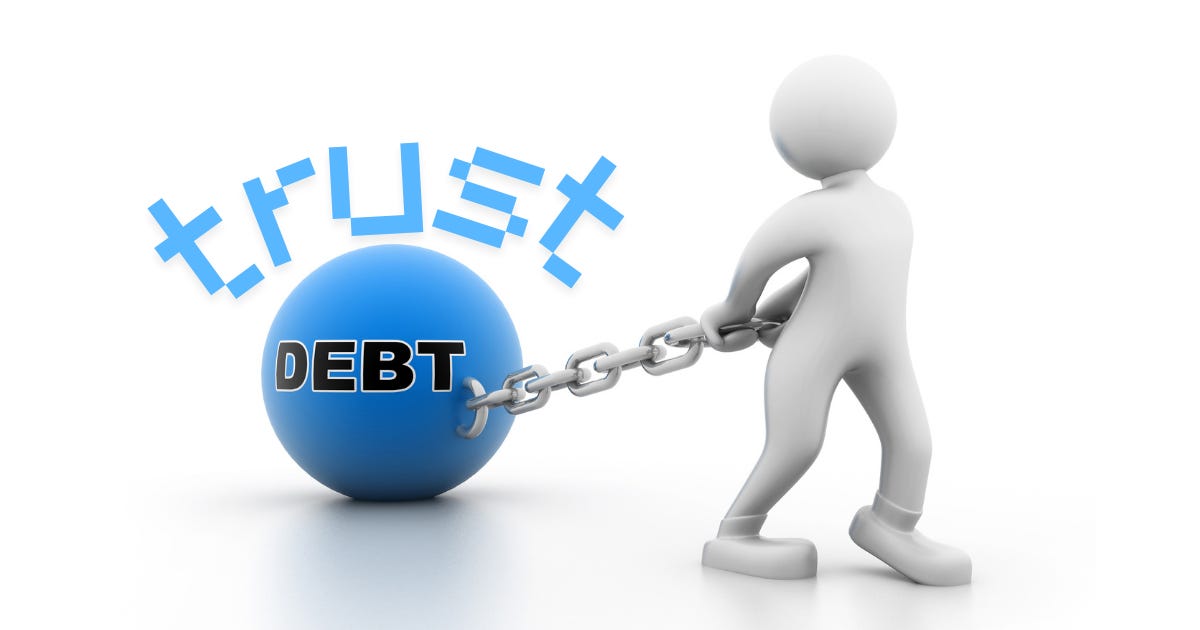
Each decision makes sense on its own. Together they accumulate something few organizations measure. Trust debt.
Trust debt is rarely dramatic. It accumulates quietly through hundreds of small decisions that optimize for the immediate over the enduring. Every shortcut taken before understanding is complete. Every assumption left unexamined because there wasn’t time. Every impressive signal accepted before someone asked whether it reflected substance or simply appearance.
The signals that matter most almost always require patience. The market rewards speed. Signal rewards attention.
Eventually the invoices begin arriving. A product people stop using. An investment thesis that quietly unravels. A strategy that looked compelling until reality introduced variables no presentation anticipated. By then the opportunity to make a different decision has already passed.
The debt wasn’t created when the outcome failed. It was created when judgment yielded to urgency.
The Advantage of Looking Further Ahead
One of the questions I’ve been asking throughout this series is why we seem so willing to pay for hindsight while resisting the smaller investment foresight requires.
Perhaps it’s because hindsight arrives with certainty. Foresight asks us to sit with uncertainty long enough for understanding to emerge. Markets rarely reward that kind of patience in the short term. Leadership often does.
I’ve spent much of my career helping organizations navigate transformation, and one lesson has surfaced again and again. The leaders who consistently earn trust are rarely the fastest people in the room. They’re the ones who know when speed creates advantage and when it quietly becomes liability. They understand that moving quickly and thinking carefully are not opposing ideas. They are complementary disciplines.
The pace of AI isn’t slowing, nor should it. The opportunities are extraordinary. The question I keep returning to is whether our capacity for discernment is expanding at the same rate as our capacity to generate answers. I’m not certain it is. That doesn’t make me pessimistic. It makes me attentive. Because I suspect the next competitive advantage won’t belong exclusively to organizations with better models, larger budgets, or faster infrastructure. It will belong to those that become unusually good at distinguishing signal from noise while everyone else is still reacting to whatever arrives first.
Foresight asks us to sit with uncertainty long enough for understanding to emerge. Markets rarely reward that kind of patience in the short term.
Artificial intelligence has dramatically expanded what we can know. The future may be shaped just as much by what we choose to trust.
The next article turns to a generation that has lived inside this digital environment and tsunami of information longer than anyone else. While much of the market interprets their hesitation as resistance, I wonder whether they’re practicing something we’ve become too busy to notice.
Not fear. Discernment.
Because surviving the tsunami won’t depend on how much information we can generate.
It will depend on how well we recognize what deserves our trust.
And that may become one of the most important human skills of the AI era.
Read more from The AI Reckoning: A Future of Trust Series
Part 1: The Hidden Cost of Intelligence, The Trust Story Hiding in Plain Sight
Part 2: The Reckoning Behind the Revenue: When the Numbers Don’t Add Up
Part 3: Rented Intelligence: Building on Borrowed Ground
Part 4: The Fragmentation Tax: Death by a Thousand Tools
Part 5: The Human Adoption Gap: We Built the Technology, We Forgot the Human
[i] That Silicon Valley Founder Reminds Me of His VC! - UCLA Anderson Review
[ii] AI-Generated “Workslop” Is Destroying Productivity
[iii][iii] https://hbr.org/2025/09/ai-generated-workslop-is-destroying-productivity
Such a thoughtful piece. AI may help us process information, yet only our humanness can provide authentic wisdom: discernment, empathy, and judgement. Technology should amplify what makes us human and not replace it. Thank you for this important reminder.
Excellent piece, Sheryl. You are discussing such salient points that need to be carefully considered in the AI era. Keep up the important work!