
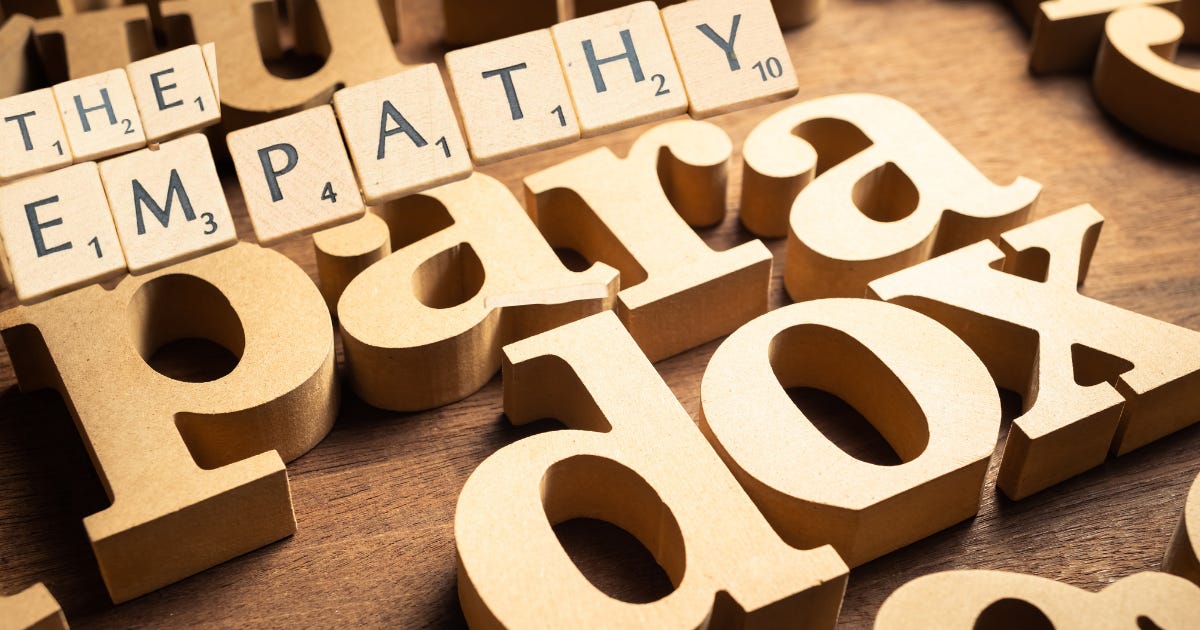
I should be good at empathy.
I am a certified coach and integrative hypnotherapist. I’m trained to listen actively, and I’ve managed more than a hundred employees over the course of my career. I know how to listen for what someone is saying, what they aren’t saying, and what may be sitting underneath both.
And I still get it wrong sometimes.
Recently, a friend going through a divorce was confiding in me. I knew my role in that moment was to stay with his experience. To listen. To ask questions. To try to understand what this felt like through his eyes. And then I veered off the path I had been trained to follow. I shared something from my own experience. The relational pull was too strong.
There is something deeply human in the instinct to reach for our own experiences as a way of connecting with someone else. I’ve been through something that feels connected to this. Maybe sharing it will help you feel less alone.
But my experience wasn’t his. In important ways, it wasn’t even close. And the moment I introduced my story, I risked shifting the center of gravity of the conversation away from him and toward me.
I knew better. That’s what makes the moment interesting to me. I knew that empathy required me to stay with his experience, yet the very human desire to connect pulled me toward my own. We often relate to one another by searching our own lives for something familiar. Sometimes that creates connection. Other times, it shifts our attention away from the person in front of us. In trying to show that we understand, we can inadvertently stop trying to understand.
I’ve been on the other side of that interaction many times. I’ve shared something difficult with someone who genuinely wanted to help, only to have them respond with an experience from their own life that they believed was similar. Suddenly, instead of feeling understood, I found myself mentally cataloguing all the ways our situations were different. Sometimes I would try to explain the difference. More often, I wouldn’t. I would leave the conversation feeling worse.
The person listening probably walked away believing we had connected. They had shared something personal. They had tried to meet me in a place they recognized. But I hadn’t needed them to recognize the place. I needed them to be curious about what it looked like from where I was standing.
That distinction has shaped the way I think about empathy.
Empathy is never about us.
I don’t mean that the person practicing empathy has no feelings. I mean that their feelings aren’t the point. The experience of empathy belongs to the person who needs the empathetic ear. My job isn’t to demonstrate how deeply I understand by finding something in my life that resembles what you’re experiencing. My job is to stay curious enough to try to imagine what this experience is like for you.
Sometimes our own experiences help us do that. They can make us more sensitive, more patient, more aware of what someone else might be carrying. But they can also become filters. We assume similarity where there isn’t any. We listen for the part of someone’s story that reminds us of our own and miss the parts that don’t.
And that distinction is at the heart of an argument I’ve been making for several years, one that still makes some people uncomfortable:
AI can be empathetic.
I first made that argument publicly two years ago in my TEDx talk, How Empathetic AI Can Change the World. The most common objection I heard then is still the objection I hear now: But AI doesn’t have feelings.
No, AI doesn’t have feelings. At least not in the way we experience them. But I don’t believe it needs to. In fact, I have come to believe something more provocative: the absence of AI’s own emotional experience may make it better at practicing empathy than most of us are.
Not because humans aren’t capable of extraordinary empathy. We are. I have been on the receiving end of it many times, sometimes from people I barely knew or never would have expected it from. Those interactions stay with me because I walked away feeling something unmistakable: seen, heard and understood.
The experience of empathy belongs to the person who needs the empathetic ear.
That is the test. Not whether the person listening has experienced what I’ve experienced, or whether they feel what I’m feeling, but whether I feel seen, heard and understood.
And perhaps we’ve been asking the wrong question about AI and empathy all along.
What Empathy Actually Requires
Part of the confusion begins with the word itself. We use empathy to describe several related but different experiences: understanding what another person is feeling, feeling something ourselves in response, caring about their distress, wanting to help, or imagining how we would feel in the same situation. We bundle these together and call them empathy. Once we do that, the argument against AI seems almost self-evident. AI doesn’t have emotions, therefore AI cannot be empathetic.
But empathy does not require me to feel what you are feeling. It requires me to try to understand what you are feeling.
Psychology commonly distinguishes between cognitive empathy, our ability to understand another person’s perspective and emotional state, and affective empathy, the emotional response we may experience to what someone else is feeling. They often occur together, but they aren’t the same thing. More emotion on the part of the listener doesn’t necessarily mean more empathy for the person who needs it.[i]
Empathy is a cognitive skill. It requires active listening, perspective-taking, curiosity, imagination and emotional recognition. It also requires enough self-awareness to notice when our own experience is entering the conversation and enough self-regulation not to let it take over.
Imagination is particularly important. We use it constantly to enter experiences we’ve never had. We watch a movie and become emotionally invested in a fictional character whose life bears no resemblance to our own. We read a novel and enter the world of someone who may have lived in another country or another century. We see a frightened animal and instinctively think, that poor dog. We don’t need a shared experience to imagine what another experience might feel like.
We do the same thing with one another. I don’t need to have lost your parent, received your diagnosis or ended your marriage to imagine what you might be experiencing. In some ways, not having had the same experience can keep me more curious because I have fewer assumptions about what yours must feel like.
Feeling can certainly accompany empathy. Often it does. But feeling isn’t the qualification for empathy, and more feeling doesn’t necessarily make us better at it. Sometimes it can do the opposite.
The absence of AI’s own emotional experience may make it better at practicing empathy than most of us are.
Emotional contagion is our tendency to take on some of the emotional state of the people around us.[ii] That emotional resonance can help us connect, but it can also backfire. If you are frightened and I become consumed by your fear, I have less capacity to help you navigate it. If your grief overwhelms me, some of the emotional space in the conversation has shifted toward my grief. At its extreme, the person who needed support can end up comforting the person who was supposed to be supporting them.
Feeling deeply for another person can be beautiful. But feeling more isn’t necessarily empathizing better. What empathy requires is that I remain close enough to understand your experience without becoming so entangled in it that I can no longer keep you at the center.
There is another part of empathy I think we often get backward. We tend to judge it from the perspective of the person providing it. I felt terrible for her. I really empathized with him. I know exactly what she’s going through. Those statements tell us something about the listener. They don’t tell us whether the other person felt understood.
I can care deeply about you and still fail to understand you. I can have lived through something remarkably similar and become so convinced that I know how you feel that I stop listening to how you actually feel.
For me, the more meaningful test happens on the other side of the interaction. Did I listen without judgment or distraction? Did I stay curious rather than decide too quickly that I understood? Did you feel safe enough to tell me what you were actually experiencing? Did you leave feeling seen, heard and understood?
We already accept that shared experience isn’t required when we’re talking about human beings. A therapist doesn’t need to have experienced every trauma of every client. A physician doesn’t need to have had cancer to understand that a patient is frightened. If shared experience were a prerequisite for empathy, our ability to empathize with people whose lives differ from ours would be remarkably limited.
And yet shared experience is one of the first things we demand when the conversation turns to AI. How can it understand grief if it has never grieved? How can it understand fear if it has never been afraid? How can it understand heartbreak if it has never loved?
Those are reasonable questions. But they hold AI to a standard we don’t hold ourselves to. The better question is whether lived emotional experience is necessary to understand and respond empathetically to someone else’s experience.
I don’t believe it is.
Empathy Is a Bridge to Trust
When we don’t feel understood, the walls go up. We protect ourselves. We explain. We defend. We withdraw. We become more careful about what we’re willing to reveal because the person on the other side doesn’t seem to understand what we’re trying to say.
When we feel genuinely heard and understood, something different happens. The walls begin to come down. We don’t necessarily change our minds or agree with the person sitting across from us, but we become more willing to stay in the conversation and consider another perspective.
This is where empathy becomes a foundation for trust.
Trust doesn’t require agreement. Neither does empathy. One of the most important things an empathetic person can do is disagree with us without making us feel dismissed. Understanding my perspective doesn’t require you to adopt it. It means you’ve taken the time to understand where I’m standing before asking me to consider standing somewhere else.
Empathy is the bridge that carries us from uncertainty to openness, and from resistance to readiness.
That matters in our closest relationships, but it also matters in leadership, healthcare, coaching, education, and anywhere we are asking another human being to navigate uncertainty or change. Before people are ready to move, they often need to feel that someone understands why moving is difficult in the first place.
And this is where the possibility of empathetic AI becomes much bigger than whether a chatbot can say the right comforting words.
What AI Doesn’t Bring to the Conversation
If empathy is about understanding another person’s experience rather than sharing it, AI’s lack of personal experience may be an advantage rather than a limitation.
AI has no divorce story to compare with mine. It doesn’t hear about my loss and immediately remember its own. It has no need to demonstrate that it understands by finding common ground. It doesn’t become uncomfortable with my emotions, distracted by what is happening in its own life, or so overwhelmed by what I’m feeling that I need to take care of it.
It can stay with me.
That doesn’t mean AI is neutral or infallible. It can misread what we’re saying, make assumptions, reinforce something that shouldn’t be reinforced, or become so agreeable that validation replaces honest reflection. AI brings biases of its own, learned through the data, systems and choices that shaped it. The absence of personal experience doesn’t mean the absence of error.
And simply sounding empathetic isn’t the same as being empathetic.
This is where design matters. An AI built specifically for empathy can be trained and fine-tuned to do more than produce the language of empathy. It can be taught to listen before responding, to look for its own assumptions and biases, to ask rather than infer when it doesn’t have enough information, and to distinguish what the person is actually expressing from patterns it recognizes in other people’s experiences.
In other words, it can be designed to resist some of the shortcuts humans need to learn to resist. It can also remain present and focused even when multiple processes are going on in the background. Something difficult for us mortals.
Active listening is a discipline for humans precisely because our minds are rarely quiet while someone else is talking. We’re interpreting, remembering, reacting, preparing our response, making associations. Sometimes we’re listening to understand. Sometimes, without realizing it, we’re listening for our turn to speak.
AI doesn’t experience that internal competition in the same way. An AI deliberately trained for empathy can attend to the words we use, the patterns in what we’ve shared, the emotional cues in our language and the context that came before, while continuing to test its assumptions rather than treating them as truth. It can ask another question instead of assuming it already knows the answer.
The paradox is that the very thing we point to as proof that AI cannot be empathetic, its lack of feelings or lived experience, may remove some of the things that make empathy difficult for us.
There are early signs that people are experiencing something like this already. A 2025 systematic review and meta-analysis of 15 studies comparing AI chatbots with healthcare professionals found that 13 reported significantly higher empathy ratings for AI.[iii] I don’t think that proves AI is universally better at empathy than humans. These studies have limitations, and a text exchange is hardly the whole of human connection.
But they do challenge the assumption that the absence of human feeling prevents a person on the other side of the interaction from experiencing empathy. It’s also a reminder that empathy isn’t a performance. It has an outcome. If I walk away feeling genuinely seen, heard and understood, what exactly are we claiming was missing simply because the intelligence listening to me didn’t experience my emotion itself?
Empathy When We Need It
The other reason I have believed in empathetic AI from the beginning is access.
We don’t schedule our hardest moments. Uncertainty doesn’t wait for our next coaching session. Anxiety doesn’t arrive only during office hours. Sometimes it’s late at night. Sometimes we’re sitting in the car five minutes before a meeting. Sometimes something has happened and we aren’t ready to tell another person yet.
And sometimes there isn’t another person.
We talk about empathy as though it is readily available to anyone who needs it. It isn’t. Therapists and coaches cost money. Managers vary enormously in their emotional intelligence. Friends and family may love us deeply but not know how to listen without advising, fixing, judging or bringing their own experiences into ours. Even the most empathetic people in our lives have jobs, families, bad days, distractions and limits of their own.
Imagine having access to an empathetic ear in the moment when everything feels bigger than it probably will tomorrow. Not something that rushes to give you an answer or simply assures you that you’re right, but something that helps you slow down, listens first, asks questions and gives you enough space to see what might be sitting underneath your immediate reaction.
Sometimes what we need first isn’t advice. We need somewhere to put what we’re carrying.
If I walk away feeling genuinely seen, heard and understood, what exactly are we claiming was missing simply because the intelligence listening to me didn’t experience my emotion itself?
When we feel threatened or overwhelmed, our thinking can narrow around whatever is immediately in front of us. A good empathetic interaction can create enough space to begin regulating, reflecting and considering what comes next.
Now imagine having access to that kind of support whenever you need it.
For the employee sitting in the parking lot before a difficult meeting. The new manager trying to navigate a conflict on her team. The caregiver at the end of an exhausting day. Someone awake at 2:00 a.m. replaying a conversation. Someone who can’t afford a coach or doesn’t have access to a therapist. Someone who simply isn’t ready to tell another human being what they’re thinking.
This isn’t an argument for replacing therapists, coaches, friends, family or human connection. Human connection and empathetic AI don’t have to be competitors.
An empathetic AI can help us prepare for a difficult conversation with another person. It can help us understand why we’re reacting the way we are before we take that reaction into a relationship. It can help us consider another person’s perspective or find words for something we haven’t yet been able to articulate. Sometimes it may help us become more ready for the human conversation.
And for people who don’t have an empathetic human available, the comparison isn’t between AI empathy and perfect human empathy. It may be between empathetic AI and no empathetic support at all. That changes the equation considerably.
Empathy Changes What Happens Next
The value of empathy isn’t confined to how someone feels during a conversation. What happens when people feel understood affects what they’re able and willing to do next.
We see it in relationships, healthcare, coaching and therapy. We certainly see it at work. A person who feels dismissed is more likely to protect their position. An employee who believes a leader doesn’t understand what a change will actually require of them is more likely to resist it. A team that doesn’t feel heard can comply outwardly while disengaging underneath.
We talk about empathy as though it is readily available to anyone who needs it. It isn’t.
Empathy doesn’t eliminate resistance, and it shouldn’t. Sometimes resistance is telling us something important. What empathy does is help us understand what is underneath it.
That distinction becomes particularly important during change. When people resist, our instinct is often to try harder to persuade them, explain the benefits again, or give them more information. But if the resistance is rooted in fear, identity, confidence, loss of control or mistrust, information may not be what they’re missing. People are more willing to examine what they believe when they don’t feel they have to defend themselves first.
This is why I don’t think empathy is soft. It has consequences. Research on empathy in the workplace has connected empathetic leadership with outcomes organizations care deeply about. In an EY survey, 87% of workers said mutual empathy between employees and leaders increases efficiency, another 87% said it boosts creativity, and 81% believed it increases company revenue.[iv]
Empathy isn’t fuzzy. It is measurable and material.
And if we can make high-quality empathetic interactions more accessible, we aren’t simply helping people feel better in difficult moments. We may be helping them regain enough openness, perspective and agency to decide what comes next.
The Responsibility of Understanding
There is another side to all of this. If an AI becomes better at understanding what frightens us, motivates us, makes us feel safe or causes us to shut down, that understanding carries enormous responsibility. The same insight that can help someone regulate, reflect or see another perspective can also be used to persuade, influence or manipulate.
We know this from human relationships. Understanding another person’s emotions doesn’t guarantee that understanding will be used in their best interest. Empathy is a capability. What matters is what we do with it.
The same has to be true for AI.
An empathetic AI should not be designed to make us dependent on it, keep us engaged longer, reinforce everything we believe, or tell us whatever will make us feel better in the moment. Feeling understood is not the same as being agreed with, and validation without discernment can become its own form of harm.
This is why the intention behind the system matters as much as its ability to understand. Is it helping me become clearer, more regulated and more capable of making my own decisions? Is it willing to challenge me when I may be missing something? Does it preserve my agency? Does it know when the right next step is to encourage me to reach out to another human being?
These aren’t peripheral design questions. They are part of what it means to build empathetic AI responsibly.
And they bring us right back to trust.
What AI Can Teach Us About Empathy
Two years after standing on a TEDx stage talking about how empathetic AI could change the world, I believe in the possibility even more strongly. The years I’ve spent building empathetic AI have also changed the way I think about human empathy.
In trying to teach a machine what good empathy requires, we are forced to become more precise about what we require of ourselves: listen before assuming, stay curious, notice bias, don’t mistake agreement for understanding, and keep the person who needs empathy at the center.
Something may also happen when we experience that kind of empathy ourselves. When we are on the receiving end, we can learn from it. A patient listener reminds us what it feels like not to be interrupted. A thoughtful question can show us the difference between curiosity and assumption. An interaction that stays focused on our experience can make us more aware of the next time we are tempted to pull someone else’s experience toward our own.
If AI can practice empathy consistently, more of us have the opportunity to experience what good empathy feels like and, perhaps, carry some of that into our interactions with one another.
I’ve already heard this from people using AI. After experiencing how patiently an AI listened and responded, my friend Brian told me it caused him to pause during a later conversation with another person. He found himself listening differently.
I find that possibility fascinating. We tend to think about AI learning from humans. What if, in this very human skill, we can also learn from AI?
Empathy is a cognitive skillset. It can be taught, modeled, and learned.
Perhaps the greatest promise of empathetic AI is that more people might have access to the experience of being understood when they need it most. And by experiencing what good empathy feels like, perhaps we all become a little better at offering it to one another.
Two years ago, I believed empathetic AI could change the world.
I still do.
Not because it feels. Because it stays.
[i] Cognitive and Affective Perspective-Taking: Evidence for Shared and Dissociable Anatomical Substrates - PMC
[ii] https://pubmed.ncbi.nlm.nih.gov/17015094/
[iii] AI chatbots versus human healthcare professionals: a systematic review and meta-analysis of empathy in patient care - PubMed
An interesting orthogonal research layer that might interest you is cognitive empathy in Autistics….it tends to have findings along this same lineage
I think it is important to distinguish between empathy as feeling (or understanding another person’s experience) and compassion as what we choose to do with that understanding. AI may be able to recognise what someone is feeling, respond in a way that makes them feel understood, and perhaps do that more consistently than many humans. The more important question, then, is how that understanding is used.
A system that understands fear, grief, uncertainty or loneliness can use that knowledge to support someone, preserve their agency and help them make a better decision. The same knowledge can be (and is currently being) used to persuade, retain attention, deepen dependence or serve the interests of the company behind the system.
That is why compassion matters more to me than whether AI can be described as empathetic. Compassion moves us from recognition to action and asks whose interests are being served, whether suffering is being reduced, and whether the person on the receiving end retains meaningful agency.