

This is Part 2 of The Human Reckoning: A Future of Trust Series
Imagine sitting in a leadership meeting where a major new initiative is being presented. The strategy is ambitious, the business case is compelling, and the executive sponsoring it is clearly enthusiastic. As the presentation concludes, the room seems aligned. There are a few questions about timing and resources, but no significant objections.
Yet several people in the room have concerns. One sees a flaw in the assumptions behind the business case. Another questions whether the organization has the capacity to execute. Someone else wonders what the changes will mean for the people expected to implement them.
Nobody raises those concerns.
Later, in smaller conversations, the reservations begin to surface. People share what they were thinking, what they didn’t agree with, and what they wish someone had asked.
What happened in that meeting?
We might describe it as a failure of communication or leadership. Perhaps it was groupthink. But there is another possibility worth considering: people were protecting themselves.
At Slalom’s recent R4 conference, the subject of self-protection surfaced several times in conversations about organizational transformation. What stayed with me was the response. There was a kind of collective nod, an unspoken recognition that everyone understood what was being described. No elaboration seemed necessary. The recognition itself seemed to be where the conversation ended.
It struck me as one of those enduring complexities of human behavior that can confound even the most experienced leaders navigating change. We recognize it, we’ve encountered it countless times, and we understand how it can undermine the very transformations we’re trying to achieve. Yet knowing it exists doesn’t necessarily bring us any closer to understanding what to do about it.
I’ve continued thinking about that moment, particularly as organizations accelerate their adoption of artificial intelligence.
We often interpret people’s behavior through what we can observe. Someone doesn’t speak up, so we assume they have nothing to add. Someone questions a new initiative, so we label them resistant. A leader stands firmly behind a decision, and we interpret that confidence as conviction.
But what if some of those behaviors are telling us less about what people believe and more about what they believe they have to lose?
And how much of what people know, think, and could contribute never makes it into the conversation because they don’t feel safe enough to speak up?
The Protective Mind: What Happens Beneath the Behavior?
Self-protection is a normal part of being human. Our brains are constantly interpreting the world around us, drawing on experience, expectations, and context to determine what deserves our attention and how we should respond.
Some threats are obvious. Others involve the possibility of losing status, being embarrassed, appearing incompetent, disappointing someone whose opinion matters to us, or being excluded from a group we value.
Neuroscience offers some insight into why these experiences can influence us so strongly. Brain systems involved in evaluating potential threats interact with those responsible for attention, memory, emotion, and decision-making. The amygdala participates in this process, but the familiar explanation that it simply hijacks our rational brain doesn’t adequately capture the complexity of how we respond. Our reactions reflect interconnected processes influenced by experience, expectations, and the meaning we assign to what is happening.
Consider two employees hearing the same announcement about a new AI initiative. One sees an opportunity to expand their capabilities and spend more time on work they find meaningful. The other hears a potential threat to the expertise they have spent years developing. They may be equally capable, equally committed to their work, and equally interested in the organization’s success.
What differs is how they interpret what the change could mean for them.
There is another important dimension here: anticipatory threat. We can respond to the possibility of a negative experience before anything has actually happened. The prospect of being embarrassed in a meeting, losing credibility with a leader, or being judged for something we don’t know may be enough to change what we’re willing to say or do.
Research on social-evaluative threat[i] helps explain why situations in which we may be negatively judged by others can produce measurable stress responses, particularly when we feel we have little control over the outcome.
Think about being asked a question in a meeting and realizing you don’t know the answer. In one environment, you might comfortably say, “I’m not sure, but let’s find out.” In another, the same admission could feel professionally risky. Previous experiences may have taught you that uncertainty is acceptable in one setting and costly in another.
We don’t always consciously recognize these assessments. We may simply become more cautious, agreeable, defensive, or reluctant to take a risk.
Of course, anticipation isn’t always misplaced. People do experience consequences for challenging authority, acknowledging mistakes, or expressing unpopular opinions. What appears to be an exaggerated response from the outside may reflect a reasonable assessment of the environment.
Self-protection serves an important purpose. The difficulty arises when it begins limiting our ability to contribute, learn, and adapt, particularly in situations where those capabilities are most needed.
The Hidden Cost of Self-Protection
Self-protection rarely announces itself as fear. More often, it appears as behavior we recognize and sometimes even reward. Someone stays quiet in a meeting. A leader stands firmly behind a decision. An employee avoids a difficult conversation. A team continues working in familiar ways despite the availability of better alternatives.
When these behaviors become patterns, they influence what gets discussed, what gets challenged, what gets learned, and ultimately, the quality of decisions being made.
Research on employee voice and silence[ii] has examined how organizations lose potentially valuable information when people withhold concerns, suggestions, and knowledge. Organizational psychologist Elizabeth Morrison’s work offers an important reminder that silence is an active part of organizational behavior, with consequences for both employees and the organizations that depend on their contributions.
Consider what may be happening beneath the surface:
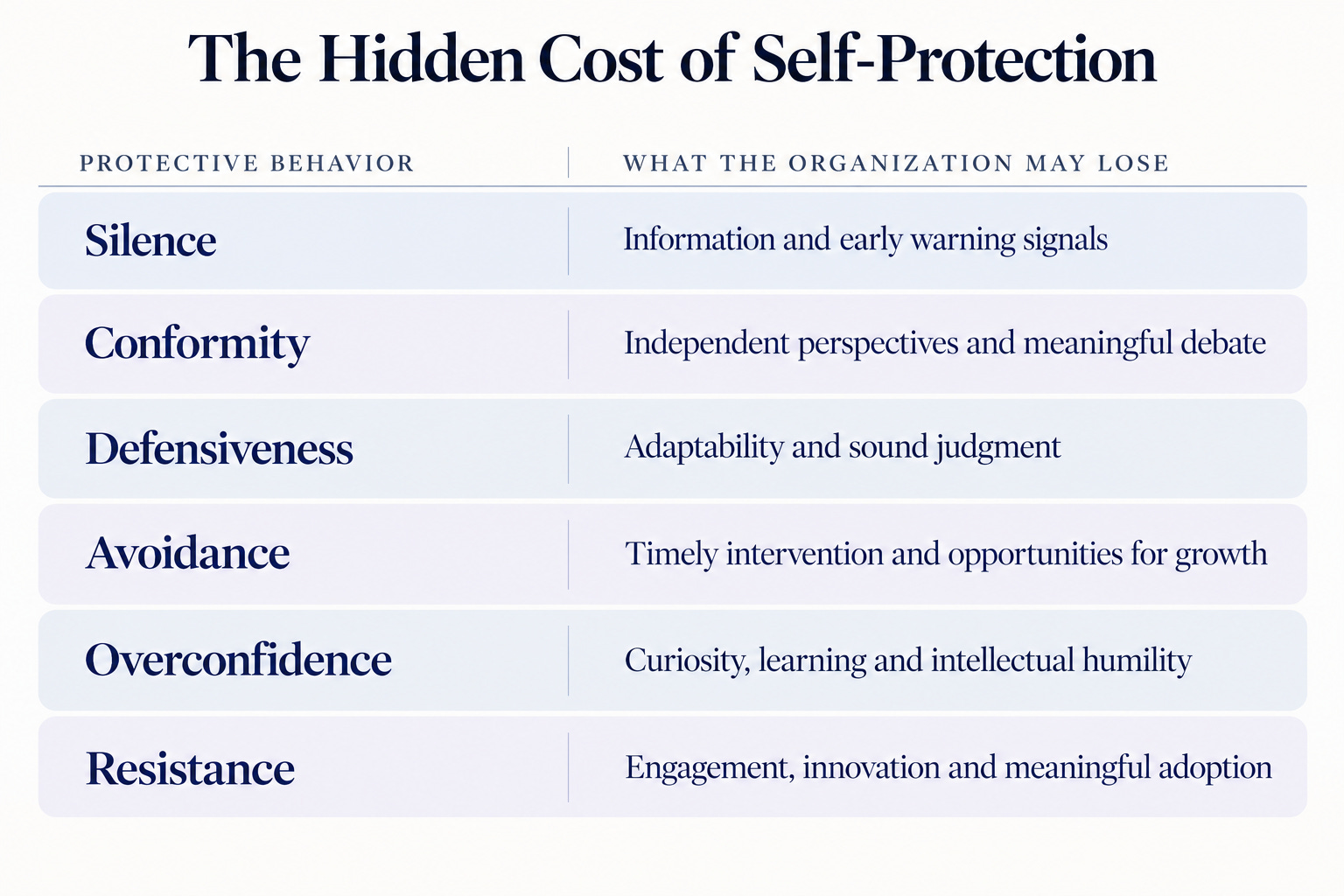
1. Silence: When important information never enters the conversation.
An employee recognizes a flaw in a proposed strategy but chooses not to raise it. Perhaps they have seen colleagues dismissed for questioning leadership, or they worry about being perceived as negative.
Their silence may protect them from an uncomfortable interaction, but it also deprives the organization of information that could have improved the decision.
2. Conformity: When apparent agreement replaces independent judgment.
A leadership team is discussing a major initiative. Several members initially have reservations, but as influential colleagues express support, some begin to set aside their concerns. Others publicly endorse a direction they haven’t fully examined because disagreeing would put them at odds with the group.
The organization gains the appearance of consensus without the benefit of independent judgment.
3. Defensiveness: When protecting a decision becomes more important than improving it.
A leader has invested considerable time, credibility, and political capital in a particular direction. When new evidence suggests a change may be necessary, reconsidering the decision can feel like admitting failure. Rather than exploring the evidence, the leader explains it away or doubles down.
The organization loses the opportunity to adjust while the cost of changing course continues to grow.
4. Avoidance: When difficult conversations become more difficult.
A manager notices that an employee is struggling with a new technology but hesitates to address it. The employee may feel embarrassed about asking for help, while the manager worries about damaging the relationship.
Both avoid the conversation, and a solvable problem becomes an ongoing source of frustration, declining confidence, and missed opportunity.
5. Overconfidence: When appearing capable takes precedence over learning.
An executive is expected to lead an AI transformation but privately feels uncertain about the technology and its implications. Rather than asking questions that might expose those gaps, they project confidence and rely on familiar assumptions.
The people around them take their certainty as a signal that the important questions have already been answered.
6. Resistance: When protecting what is familiar limits what becomes possible.
An experienced employee continues using an established process despite the introduction of a tool that could make their work easier. From the outside, the behavior looks like resistance to change. But the employee may be concerned about losing expertise, autonomy, or the sense of competence they have developed over many years.
Until those concerns are understood, additional training or stronger adoption targets may do little to change their behavior.
Each behavior may make sense to the person in the moment, even as its consequences accumulate across the organization. And although self-protection can contribute to these responses, it isn’t the only possible explanation.
Silence may reflect thoughtful restraint, and resistance may be a legitimate response to a poorly conceived initiative.
The more revealing question is whether the organization has created conditions in which protecting oneself feels safer than contributing fully. An organization can be filled with highly capable people and still fail to benefit from much of what they know.
Psychological Safety: The Conditions That Change the Equation
Psychological safety has become a familiar term in leadership conversations, but I wonder whether we always appreciate what it actually requires.
Harvard researcher Amy Edmondson introduced team psychological safety as a shared belief that a team is safe for interpersonal risk-taking.[iii] Her foundational research connected psychological safety with the learning behaviors that allow teams to identify mistakes, ask questions, seek feedback, and improve.
In practical terms, it means people can acknowledge what they don’t know, challenge assumptions, report mistakes, and offer unpopular perspectives without anticipating humiliation or punishment simply for speaking up.
Psychological safety doesn’t mean that everyone feels comfortable all the time. It doesn’t eliminate accountability, guarantee agreement, or protect ideas from scrutiny. A psychologically safe environment should make it easier to challenge weak ideas, have difficult conversations, and hold one another to high standards.
Self-protection serves an important purpose. The difficulty arises when it begins limiting our ability to contribute, learn, and adapt, particularly in situations where those capabilities are most needed.
Psychological safety doesn’t remove the risk of being wrong. It changes the perceived risk of being honest.
There is a meaningful difference between a leader who says, “My door is always open,” and one who consistently demonstrates that difficult information is welcome.
Consider what happens when someone challenges a decision in a meeting. The leader’s response may be thoughtful and curious, or it may be impatient and defensive. Perhaps the leader interrupts, dismisses the concern, or immediately explains why the original decision was correct.
Everyone in the room is observing.
The person who spoke up learns something about the consequences of challenging authority. But so does the person who was considering asking a question, the colleague who noticed a problem, and the employee who wasn’t sure whether their perspective would be welcome. One interaction can influence the willingness of people who weren’t directly involved to speak up the next time.
And these observations accumulate. People learn which questions are welcome, how disagreement is handled, and whether admitting uncertainty affects how they are perceived. Over time, those experiences can become shared expectations about what is safe within the team.
The same process can work in a more constructive direction. When leaders demonstrate curiosity, acknowledge their own uncertainty, and engage seriously with disagreement, they provide visible examples of how people can interact without having to protect their status at every turn.
But psychological safety also asks something of the person receiving the challenge.
We often focus on whether employees feel safe enough to speak. The conversation becomes productive only when someone else is willing to hear what is being said. A leader may invite contrarian perspectives, but if those perspectives threaten their sense of competence or authority, their own protective instincts can interfere with the very openness they are trying to encourage.
Learning to recognize that response in ourselves is part of creating psychological safety for others. A statement of values or a single workshop cannot establish these conditions. They develop through repeated experiences, especially when the conversation is difficult and the stakes are high.
And the higher the stakes, the more valuable dissent may become, even as the perceived personal cost of offering it increases.
When AI Enters the Room, What Changes?
Artificial intelligence introduces a particularly complex set of questions about professional identity, competence, autonomy, and the future of work.
For some employees, AI represents an exciting opportunity to expand what they can accomplish. For others, it raises questions they may be reluctant to voice.
Will my experience still matter? Will I be expected to accomplish more with fewer resources? What happens if I can’t learn this quickly enough? If I use AI, will people question whether the work is really mine? If I don’t use it, will I be seen as falling behind?
These concerns can exist simultaneously within the same person.
Leaders are navigating their own uncertainty. They are being asked to make significant investments, set direction, and demonstrate confidence in technologies whose capabilities and limitations are still evolving. An executive may feel pressure to appear knowledgeable before they have had sufficient opportunity to learn. A manager may worry about how AI will change the value of their team’s work. A senior professional may struggle with the possibility that skills developed over decades are becoming easier for others to replicate.
There is a connection here to imposter syndrome, or what researchers often call the impostor phenomenon. I’ve explored this intersection of technology and identity in What Happens When AI Triggers the Imposter Within? Someone who already questions whether others overestimate their abilities may find that an unfamiliar technology intensifies those doubts. They may hesitate to ask basic questions, avoid participating in demonstrations, or work harder to conceal what they haven’t yet learned.
Even highly accomplished people are being placed in situations where their existing expertise doesn’t necessarily translate into immediate confidence. The pressure to appear capable can interfere with the curiosity and willingness to learn that would help them become capable.
AI also introduces questions about visibility. Employees may wonder who can see how they are using AI, whether their questions are being monitored, or how their reliance on the technology might be interpreted. Someone who would comfortably ask a colleague for help may hesitate to ask the same question through a system they believe could be evaluated by their employer. Another person may conceal their use of AI because they worry that acknowledging assistance will diminish the value of their work.
These concerns will vary depending on the technology, organizational policies, and the transparency surrounding its use. But the perception of being observed can influence behavior even when the employee doesn’t fully understand what information is actually visible.
An organization may launch an AI initiative, provide training, establish usage targets, and conclude that employees are resistant when adoption falls short of expectations. Meanwhile, employees may be experimenting privately, avoiding discussion of errors, or withholding concerns about the quality of AI-generated work.
The organization sees the adoption numbers. It may have little understanding of the experience behind them.
And when leaders feel compelled to demonstrate certainty while employees feel unable to challenge assumptions, important information can be lost at precisely the moment it is most needed.
An organization can move quickly through implementation while leaving the questions that determine meaningful adoption largely unanswered.
When Self-Protection Becomes Disengagement
There is another consequence of self-protection that may be less visible because it develops gradually.
Imagine an employee who raises a concern about a new process and is dismissed. The next time, they choose their words more carefully. Eventually, they stop raising concerns altogether.
At first, this may be a conscious decision to avoid conflict. But repeated experiences can change the person’s relationship with the organization. They begin to question whether their perspective matters, whether their efforts can influence outcomes, and whether anyone is genuinely interested in what they have to say.
The protective response that began with one uncomfortable interaction can become a broader pattern of withdrawal.
People learn which questions are welcome, how disagreement is handled, and whether admitting uncertainty affects how they are perceived.
That gradual loss of participation raises another question about what happens to a person’s sense of agency. Psychologists Richard Ryan and Edward Deci have spent decades studying human motivation through self-determination theory,[iv] which identifies autonomy, competence, and relatedness as fundamental psychological needs. Their research helps explain why people are more likely to engage meaningfully when they experience a sense of choice, capability, and connection.
When employees repeatedly feel that their input has little influence, their sense of agency may weaken. They may continue completing assigned work while becoming less willing to contribute ideas, challenge assumptions, or invest energy in improving how things are done.
Cynicism can enter the picture as well. Someone who once believed change was possible may begin anticipating that new initiatives will follow familiar patterns. Leadership asks for feedback, but the decision has already been made. Employees are encouraged to experiment, but mistakes carry consequences. The organization talks about empowerment while important choices remain beyond employees’ influence.
Over time, “Why bother?” can become a reasonable conclusion from the employee’s perspective.
Research on organizational change has examined how leadership relates to employees’ openness, resistance, and cynicism about change. These responses are influenced by context and experience, and they shouldn’t be treated as fixed personality traits.
The consequences may extend beyond participation. Employees who feel increasingly disconnected may reduce their discretionary effort, withdraw emotionally, or begin looking for opportunities elsewhere. Not everyone who becomes cautious will disengage, and not everyone who disengages will leave. But the possibility of that progression deserves attention.
Organizations may notice declining engagement or increasing turnover without recognizing the smaller interactions that preceded them. What began as an effort to protect oneself from an uncomfortable experience may eventually become an effort to protect oneself from the organization.
What Leaders May Be Missing
Leaders often look at resistance as something happening within their teams. But their own responses are part of the environment people are responding to.
An impatient reaction to a question, a decision defended too quickly, or a mistake treated as evidence of incompetence can change what employees are willing to share the next time.
This creates a challenge because the feedback leaders receive may become less candid precisely when they need it most. The more consequential the decision, the more personally risky disagreement may feel. And the more confident a leader appears, the more difficult it can become for others to introduce uncertainty.
By the time a concern reaches an executive, it may have been softened, delayed, or filtered through several layers of self-protection. Some concerns never reach them at all.
The result can be a distorted picture of organizational reality.
When employees repeatedly feel that their input has little influence, their sense of agency may weaken.
A leader may believe employees support a change because nobody has objected. They may interpret completed training as readiness or increased AI usage as evidence of meaningful adoption. Yet these measures reveal relatively little about whether employees trust the direction, feel capable of participating, or believe their concerns will be heard.
This is one reason I believe we need to pay closer attention to the human experience of transformation.
Leaders can begin by examining the assumptions they make about the behavior they observe. Someone who appears resistant may be raising a legitimate concern. An employee who remains silent may have learned that speaking up carries a cost. A team that seems disengaged may have stopped believing its contributions will influence the outcome.
Understanding those possibilities doesn’t mean every objection is justified or every concern should determine the direction of change. Difficult decisions still have to be made, and people remain accountable for their work.
But the way leaders respond to disagreement, uncertainty, and mistakes influences whether they continue receiving the information needed to make those decisions well.
There is also an individual responsibility here. We can become more aware of our own protective responses and examine whether they reflect a genuine risk or an assumption we haven’t questioned. We can learn to pause before dismissing an uncomfortable idea, acknowledge uncertainty without treating it as failure, and become more willing to hear perspectives that challenge our own.
These are learned capabilities, and they require practice. The environment around us can either support that practice or make it considerably more difficult.
What Becomes Possible When We Feel Safe Enough?
Let’s return to the meeting where everyone appeared to agree.
Imagine that the employee who questioned the business case felt comfortable raising the concern, and the leader listened without interpreting the question as a challenge to their authority. Others began contributing perspectives they had initially withheld.
Perhaps the team discovers a significant problem and changes direction. Or perhaps the assumptions hold up under scrutiny, and the decision becomes stronger as a result.
Either outcome would be more valuable than moving forward without the benefit of what people knew.
As AI becomes increasingly capable of producing information, analysis, recommendations, and decisions, our ability to interpret and challenge those outputs becomes more consequential. We need people who can acknowledge uncertainty, recognize their own assumptions, and contribute perspectives that others may not see. And we need leaders who can hear uncomfortable information without immediately defending their positions.
These capabilities already exist to varying degrees within our organizations. But they don’t always make it into the room.
Self-protection will always be part of the human experience. It helps us recognize genuine risks and navigate situations where caution is warranted. But when our protective instincts prevent us from speaking up, questioning assumptions, or considering different perspectives, we lose access to some of the very capabilities we need most.
We spend enormous resources recruiting, developing, and retaining talented people. Perhaps we should give equal attention to creating the conditions in which they feel able to contribute fully.
After all, how much intelligence is already present in our organizations that we never get to hear?
Sources
[i] Dickerson, S. S., & Kemeny, M. E. (2004). Acute stressors and cortisol responses: A theoretical integration and synthesis of laboratory research. Psychological Bulletin, 130(3), 355–391 https://doi.org/10.1037/0033-2909.130.3.355?utm_source=chatgpt.com
[ii] Morrison, E. W. (2023). Employee voice and silence: Taking stock a decade later. Annual Review of Organizational Psychology and Organizational Behavior, 10, 79–107 https://doi.org/10.1146/annurev-orgpsych-120920-054654?utm_source=chatgpt.com
[iii] Edmondson, A. (1999). Psychological safety and learning behavior in work teams. Administrative Science Quarterly, 44(2), 350–383 https://doi.org/10.2307/2666999?utm_source=chatgpt.com
[iv] Ryan, R. M., & Deci, E. L. (2000). Self-determination theory and the facilitation of intrinsic motivation, social development, and well-being. American Psychologist, 55(1), 68–78 https://doi.org/10.1037/0003-066X.55.1.68?utm_source=chatgpt.com