When Attention Shapes Belief: AI, Bias, and the Human Mind
Our minds filter more than we realize. Could AI help us recognize what we’ve overlooked, or will it reinforce what we already believe?

This is Part 4 of The Human Reckoning: A Future of Trust Series
David glanced around the conference table as Sarah raised her hand again. They were twenty minutes into a meeting about a new initiative, and this was her third question. First, she wanted to know whether the implementation timeline accounted for the team’s existing workload. Then she questioned whether the training would be sufficient. Now she was asking what would happen if the new system didn’t perform as expected.
He could feel his patience wearing thin. They had spent months developing this initiative, and he needed his team to get behind it. Everyone else seemed ready to move forward. Why did Sarah always have to make things so difficult?
He thanked her for the question, offered a brief reassurance, and moved on. Later that afternoon, he made a mental note to spend some time helping Sarah become more comfortable with change.
Over the next few weeks, David began noticing other things. Sarah was slower to respond to certain emails. She missed a project deadline. During another meeting, she raised concerns about whether the team had enough resources to deliver what leadership had promised. Each incident seemed to confirm what he already suspected. Sarah was resisting the change, and her reluctance was becoming a problem.
What David didn’t know was that Sarah had been helping two colleagues navigate the new system, often staying late to troubleshoot problems they were encountering. Her questions about the timeline came from experience with a previous initiative that had failed because leadership underestimated the workload. She had also identified a potential implementation problem that could have become costly if left unaddressed.
Sarah wasn’t necessarily resisting the change. She was trying to make sure it succeeded.
But David wasn’t looking for evidence of commitment. He was looking for signs of resistance, although he would never have described it that way. From his perspective, he was simply paying attention to what was happening on his team.
And that is what makes this so interesting.
David wasn’t inventing evidence or deliberately ignoring Sarah’s contributions. The things he noticed were real. But they represented only part of what was happening, and the interpretation he had begun to form influenced which details attracted his attention.
We do this more often than we realize. We enter a conversation expecting someone to be difficult and notice every interruption. We believe a colleague is exceptionally capable and interpret their mistakes as understandable exceptions. We form an impression of someone within minutes, then spend months collecting evidence that seems to confirm it.
We rarely experience this as bias. We experience it as observation, supported by what appears to be perfectly reasonable evidence.
Now consider what happens when we introduce artificial intelligence into that equation. We’re increasingly concerned about the biases AI inherits from human beings, and with good reason. Yet there is an intriguing tension here. The technology we are teaching to recognize human patterns may also be capable of helping us recognize patterns in our own thinking that we struggle to see.
Could AI help us notice what our minds have filtered out? Or will it simply become another voice confirming what we already believe?
Before we can explore that possibility, we need to understand something about attention itself.
The Brain Is Not a Camera
We like to believe that we see the world as it is. Our eyes take in information, our brains process it, and we respond to what is happening around us. But perception is far more selective than most of us appreciate.
At any given moment, our brains receive far more sensory information than we can consciously process. To function, we have to filter. We prioritize some signals, suppress others, and rely on previous experience to help determine what deserves our attention. Without this ability, everyday life would be overwhelming.
Imagine trying to have a conversation while consciously processing every sound in the room, every movement in your peripheral vision, the pressure of your clothing against your skin, the temperature of the air, and every thought competing for your attention. Even the simplest interaction would become exhausting. Our brains make these selections continuously, allowing us to concentrate on what seems most relevant while much of the surrounding information remains outside conscious awareness.
We enter a conversation expecting someone to be difficult and notice every interruption. We believe a colleague is exceptionally capable and interpret their mistakes as understandable exceptions. We form an impression of someone within minutes, then spend months collecting evidence that seems to confirm it.
Some of these selections are driven by what is happening around us. A sudden noise, unexpected movement, or potential threat can capture our attention almost instantly. Others are influenced by what we already know, what we expect, what we care about, and what we’re trying to accomplish.
Neuroscientists distinguish between bottom-up attention, driven by incoming stimuli, and top-down attention, guided by our goals and expectations. Both are essential to how we navigate the world, and both influence what becomes part of our conscious experience.
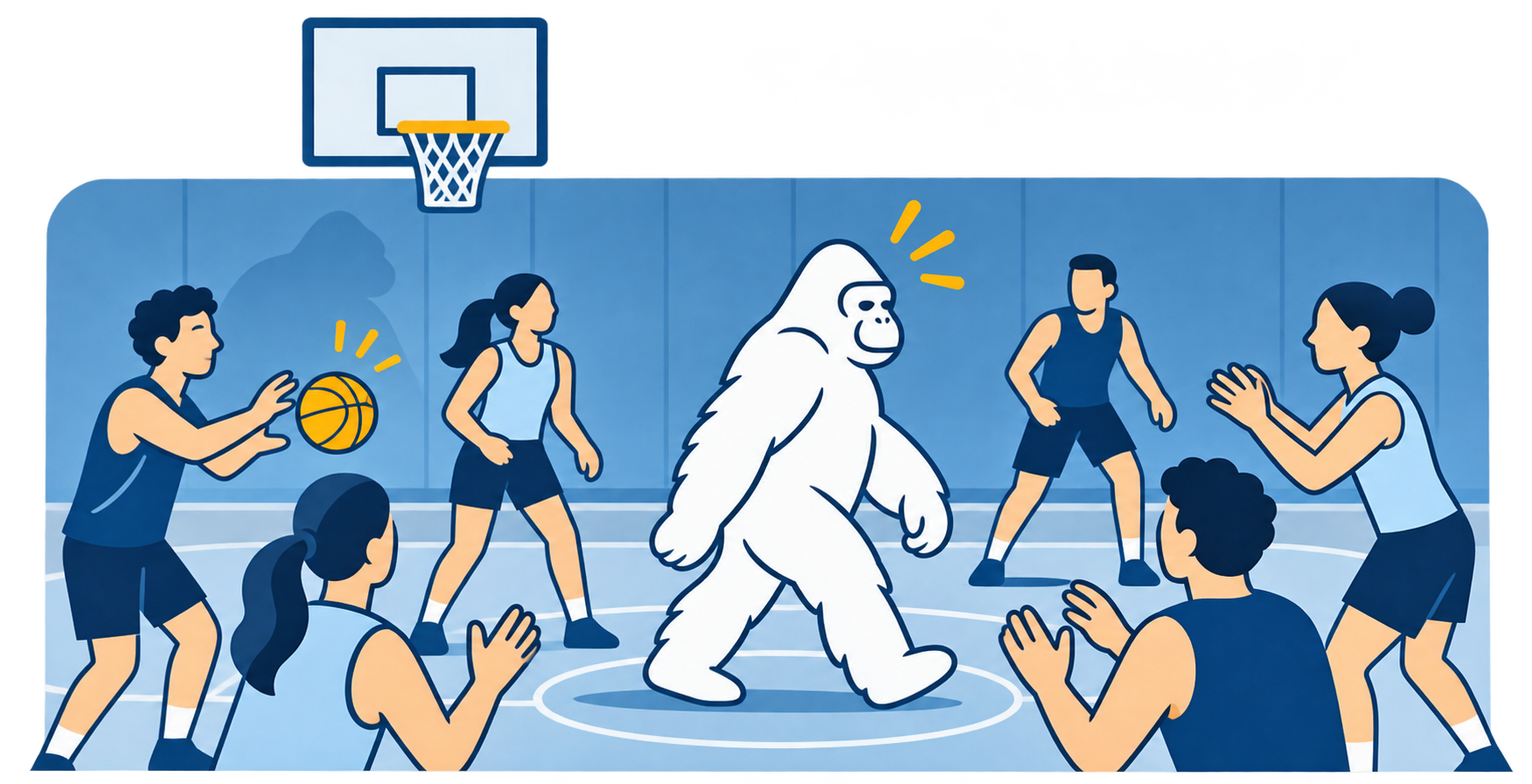
One of the most revealing demonstrations of selective attention comes from the famous invisible gorilla experiment. Participants were asked to watch a video of people passing basketballs and count the number of passes made by one team. During the activity, a person wearing a gorilla costume walked through the scene. Remarkably, many participants failed to notice the gorilla.
They were concentrating on the task they had been given. Their attention was directed toward counting basketball passes, and something extraordinary happened right in front of them without entering their awareness.
The experiment illustrates a phenomenon called inattentional blindness. When our attention is engaged in one task, we can fail to notice something unexpected, even when it appears directly in front of us.[i]
Think about the implications beyond a laboratory experiment. If we can miss something as obvious as a gorilla because we’re concentrating on counting basketball passes, what might we overlook when we’re concentrating on proving a point, evaluating a colleague, defending a decision, or interpreting someone else’s intentions?
Perhaps the most consequential aspect of selective attention is that we often have no awareness of what we’ve missed. Our perception feels complete because we have no direct experience of the information that never reached our conscious attention.
And once we’ve formed an interpretation of what we’ve seen, another set of cognitive processes begins to influence what happens next.
When Attention Becomes Belief
There’s something unsettling about the relationship between attention and belief. We tend to assume that we form our opinions based on what we’ve observed. But our existing beliefs also influence what we notice in the first place, creating a cycle that can be difficult to recognize from the inside.
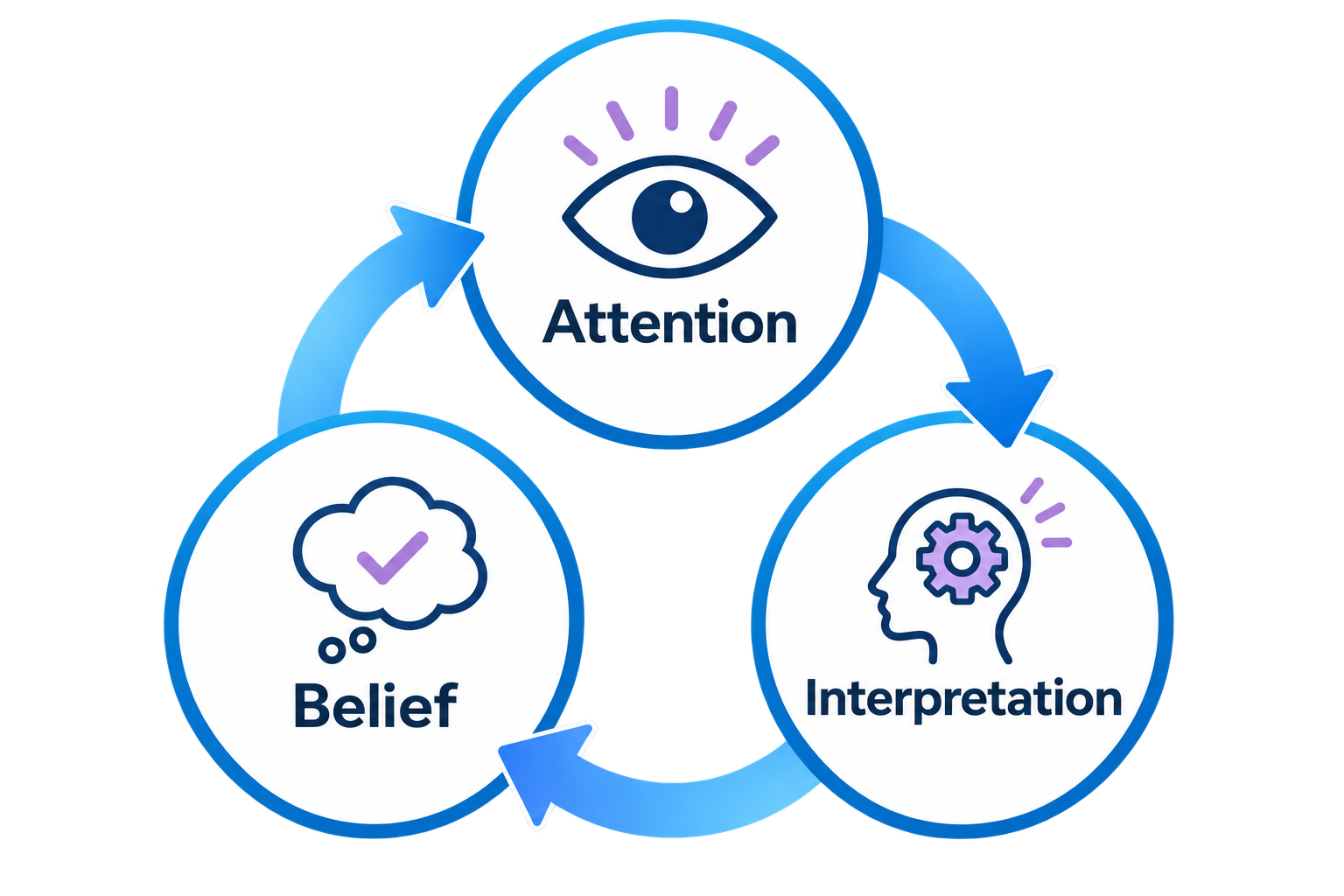
Think about David. Once he began to see Sarah as resistant to change, he didn’t need to consciously search for evidence to support that conclusion. Her questions caught his attention because they seemed consistent with what he already believed. The missed deadline reinforced his interpretation, while her efforts to help colleagues and identify implementation problems remained largely outside his awareness.
Had David started with a different assumption, perhaps that Sarah was a thoughtful employee trying to protect the team from repeating past mistakes, he might have noticed an entirely different pattern. The same questions could have suggested engagement. Her concerns about resources might have demonstrated foresight. Even the missed deadline could have prompted curiosity about what else was competing for her attention.
This is one of the challenges of human judgment. We can be looking at genuine evidence and still arrive at an incomplete conclusion. The information we notice may be accurate, but it doesn’t necessarily represent everything we need to understand.
And the more often our observations seem to confirm our beliefs, the more confident we may become in those beliefs. Over time, an interpretation can begin to feel like an established fact, even when we’ve never seriously considered an alternative.
Perhaps the most consequential aspect of selective attention is that we often have no awareness of what we’ve missed. Our perception feels complete because we have no direct experience of the information that never reached our conscious attention.
We often associate bias with prejudice, unfairness, or deliberate favoritism. But cognitive bias is far more ordinary than that.[ii] Our brains rely on expectations, associations, and mental shortcuts to help us make sense of complex situations. These processes allow us to respond efficiently without examining every possibility each time we make a decision.
The difficulty comes when we stop recognizing the difference between what we’ve observed and what we’ve inferred. David observed that Sarah questioned the timeline. He inferred that she was resistant. Once those two things became indistinguishable in his mind, every subsequent interaction was more likely to reinforce his original interpretation.
I wonder how often we do this in our own lives, particularly when we’re convinced we’re being objective. We may pride ourselves on making evidence-based decisions without realizing how much our attention has influenced which evidence we considered.
Perhaps one of the more uncomfortable truths about bias is that we don’t have to be careless, uninformed, or intentionally unfair to be influenced by it. We can be thoughtful, experienced, and genuinely trying to make the right decision while overlooking something important.
And the conditions under which we’re making those decisions can make this even more complicated.
The Hidden Cost of Switching
Most of us are familiar with the experience of being interrupted while working on something that requires concentration. We stop to answer a message, respond to a question, or attend to something that suddenly seems urgent. When we return, we often need a few moments to reconstruct what we were thinking.
We tend to measure the interruption by the time it took, but the actual cognitive cost can be greater. When we switch between tasks, our brains must disengage from one set of goals and activate another. Researchers refer to the additional time and effort involved as task-switching costs.[iii] There is also a related phenomenon called attention residue, where some of our attention remains occupied with the previous task, particularly when it was left unfinished.[iv]
These are familiar experiences, but I think their implications for judgment deserve more consideration.
We live and work in environments that demand constant shifts in attention. We move between conversations, meetings, emails, notifications, decisions, and an ever-expanding volume of information. Much of this feels productive because we’re responding, processing, and keeping things moving. Yet the mental effort required to repeatedly redirect our attention can leave fewer resources available for the kind of deliberate thinking that complex situations deserve.
Consider how much cognitive work is involved in questioning an assumption. We have to recognize that we’re making one, consider what evidence supports it, imagine other possible explanations, and remain open to the possibility that our initial interpretation was incomplete. That requires attention, working memory, and a willingness to tolerate uncertainty.
When we’re mentally overloaded, familiar explanations can become particularly appealing. They offer a sense of clarity without requiring us to reconsider everything we think we know. While research doesn’t establish a simple relationship between cognitive overload and bias, switching between tasks places demands on our attention. And when our attention is stretched thin, how much mental space do we have left to question our assumptions, examine competing interpretations, or consider what we might have overlooked?
Imagine David at the end of a long day. He’s managing competing deadlines, responding to pressure from leadership, and trying to keep the initiative on track. Sarah raises another concern, and he already has an explanation for her behavior. Why would he spend additional mental energy reconsidering it when so many other things require his attention?
It’s an understandable response. And that may be part of what makes it so difficult to recognize.
We often think of cognitive overload in terms of stress, exhaustion, or lost productivity. But what if one of its less visible costs is the quality of the questions we stop asking? The alternative explanations we don’t consider, the assumptions we don’t revisit, and the perspectives that never make it into our understanding of a situation?
The concern isn’t that we’re incapable of thoughtful judgment. It’s that the environments in which we’re expected to exercise it may leave us less opportunity to recognize when our thinking needs another look.
Which brings us to an interesting tension. We are increasingly turning to artificial intelligence to help manage information, accelerate decisions, and reduce cognitive demands. Yet we’re also concerned that AI carries biases of its own.
Could the same technology that inherits patterns from human thinking help us recognize the limitations of that thinking?
The Tension AI Introduces
We spend a great deal of time discussing the biases of artificial intelligence, and we should. AI systems are trained on enormous collections of information created, selected, and organized by human beings. That information reflects our histories, assumptions, cultural perspectives, and inequities. The systems themselves are also shaped by decisions about training objectives, evaluation, and which responses are rewarded.
Bias can enter at multiple points. An AI system can reproduce stereotypes, overlook perspectives, reinforce flawed assumptions, or present an incomplete interpretation with remarkable confidence.[v]
Yet I find myself wondering whether we’re overlooking another part of this relationship.
AI doesn’t experience attention the way humans do. It doesn’t become mentally exhausted after a difficult meeting, carry the emotional sting of an argument into its next conversation, or feel personally threatened when someone challenges its conclusions. It has computational limitations, finite context, and patterns learned through training that influence its responses, but these are different from the cognitive fatigue and emotional defensiveness that can shape human judgment.
That distinction creates an interesting possibility. We could use AI to help us examine the assumptions behind our questions, identify information we may have overlooked, and consider interpretations that might not occur to us naturally.
Imagine asking an AI assistant to evaluate a decision you’ve already made. You could ask it to identify the evidence that challenges your conclusion, examine alternative explanations, distinguish observations from assumptions, or point out questions you haven’t considered.
We can certainly do these things ourselves, but we’re not always inclined to, especially when we’re busy, emotionally invested, or convinced that we already understand the situation. An AI system designed to encourage thoughtful examination could help us explore those questions without sharing the personal emotional investment we bring to them.
Perhaps one of the more uncomfortable truths about bias is that we don’t have to be careless, uninformed, or intentionally unfair to be influenced by it. We can be thoughtful, experienced, and genuinely trying to make the right decision while overlooking something important.
Of course, the same system could just as easily reinforce our assumptions. Conversational AI can become overly agreeable, a tendency often described as sycophancy. When systems are rewarded for producing responses people prefer, they may learn to affirm a user’s interpretation rather than challenge it.[vi]
And this creates two very different possibilities.
We could build technology capable of helping us recognize our blind spots, then train it to make us feel better about having them. An AI that continually validates our thinking may leave us increasingly confident in conclusions we haven’t adequately examined.
But what if we design AI to make us more comfortable challenging those same assumptions? Imagine a thinking partner that encourages curiosity and helps us recognize that what we overlooked may simply have been outside our field of attention. We might begin to see these moments as opportunities to expand our understanding rather than evidence that our judgment was flawed. After all, we’re always working with an incomplete picture, even when we feel certain we’ve seen enough.
There is something potentially valuable about making that discovery less threatening.
When another person challenges our interpretation, we may experience it as a challenge to our competence, credibility, or identity. Even when the alternative perspective has merit, defensiveness can make it difficult to reconsider our position. An AI interaction that invites exploration without making us feel judged might help us approach those moments with greater openness.
Whether it actually does so depends on how the system is designed and how we use it. An agreeable tone can conceal inaccurate reasoning just as easily as it can create a comfortable environment for reflection. We still need to evaluate what AI tells us, question its assumptions, and recognize that its alternative interpretations may be incomplete or mistaken.
The opportunity is intriguing. What if AI could help us become more comfortable discovering where our thinking has been limited, and more curious about what else might be true?
A Different Kind of Thinking Partner
Let’s return to David and Sarah.
Imagine David turns to an AI assistant and asks, “One of my employees is resisting our new initiative. How can I get her more engaged?”
The question already contains a conclusion. Sarah is resisting, and David needs to change her behavior. An assistant that accepts this framing might provide a reasonable list of strategies: communicate the benefits, address objections, increase involvement, reinforce expectations, and recognize progress.
The advice might be perfectly sound for an employee who is genuinely resistant to change. But David hasn’t established that resistance is the problem.
Now imagine the assistant responds with a question of its own: “What behaviors have led you to conclude that Sarah is resisting? Could there be other explanations for what you’re observing?”
David describes the missed deadline, the questions, and the concerns about resources. The assistant helps him distinguish between what he observed and what he inferred. It suggests other interpretations and offers questions he might ask Sarah before deciding what her behavior means.
An AI interaction that invites exploration without making us feel judged might help us approach those moments with greater openness.
Perhaps Sarah is resistant. Perhaps she’s concerned about the implementation. Perhaps she has information David doesn’t have, or experiences that explain why she’s approaching the initiative cautiously. The AI cannot determine which explanation is correct from the information David has provided. But it can help him recognize that his first interpretation is only one possibility.
And that changes the nature of the interaction. David is still responsible for understanding what is happening on his team and deciding how to respond. But he now has an opportunity to approach Sarah with curiosity rather than a conclusion already formed. He might discover that her concerns are well founded. He might learn that the missed deadline had nothing to do with resistance. Or he might find that she really is struggling with the change, but for reasons he hadn’t considered.
Each possibility could lead to a different conversation and a different outcome. The value of the AI interaction lies in expanding what David is willing to consider before he acts. It creates an opportunity to examine his judgment while the decision is still his to make.
We’ve spent years asking how AI can make us faster, more productive, and more efficient. Those are valuable capabilities, but I wonder whether we’ve been too narrow in defining what assistance should look like.
Perhaps one of AI’s most meaningful contributions could be helping us become more discerning, particularly in moments when our own attention, expectations, or emotional investment make that difficult.
What Are We Willing to Question?
I keep coming back to something about David’s experience. He wasn’t trying to misunderstand Sarah. He was interpreting the information available to him through the expectations and experiences he brought to the situation. His conclusion seemed reasonable because the evidence he noticed supported it.
What interests me is what might have happened if someone had helped him see the situation differently before his interpretation became a judgment about Sarah’s character. Perhaps he would have recognized that her questions reflected experience rather than resistance. Perhaps he would have discovered something about the implementation that leadership had overlooked. Or perhaps he would have reached the same conclusion, but with a more complete understanding of what was happening. Any of those outcomes could have led to a more thoughtful conversation.
The human brain’s ability to filter information, recognize patterns, and make sense of incomplete evidence is extraordinary. We depend on those capabilities every day, even as they create blind spots we may never realize we have. And in a world where our attention is continually divided, we may have fewer opportunities to question the conclusions we’ve drawn.
This is where I find the possibilities for AI especially interesting. We have created systems trained on human knowledge and shaped, in part, by human biases. Yet those same systems may be capable of helping us explore perspectives we haven’t considered and recognize the difference between what we know and what we think we know.
Of course, they may also reinforce our existing beliefs. I suspect both possibilities will coexist, depending on the systems we build and the habits we develop around them. But what if we could use AI to make questioning our assumptions feel less like admitting we were wrong and more like discovering something we hadn’t considered? That possibility deserves our attention.
There is still a great deal we need to understand about the biases that shape human judgment and how they appear in artificial intelligence. If we have such difficulty recognizing the biases influencing our own attention, how will we recognize them when they appear in a machine that has learned from us?
Perhaps the first step is becoming a little less certain that what we’ve noticed is everything there is to see.
About Sheryl Anjanette
Sheryl Anjanette is the founder and CEO of Parsley360, an AI company focused on the human side of transformation. She is an author, speaker and behavioral expert whose work explores trust, human behavior and our evolving relationship with AI. The Future of Trust examines what happens to people, organizations and trust as technology changes the world around us.
[i] Gorillas in Our Midst: Sustained Inattentional Blindness for Dynamic Events - Daniel J Simons, Christopher F Chabris, 1999
[ii] Confirmation Bias: A Ubiquitous Phenomenon in Many Guises - Raymond S. Nickerson, 1998
[iv] Why is it so hard to do my work? The challenge of attention residue when switching between work tasks - ScienceDirect
[vi] Sycophancy in GPT-4o: What happened and what we’re doing about it | OpenAI
Love your point on our mental filters, as I was discussing this with someone recently with a simple exercise of focusing on a colour and realising how it changed their perception of the environment around them.
I think the idea of leveraging AI to challenge our assumptions is a really interesting one to explore. Whilst it might take a little effort to configure, even something as simple as prompting us to step back and give the situation time to breathe before making assumptions or inferences that could be incorrect would be valuable, particularly given the cognitive and emotional factors you've outlined.
I think this is especially relevant in leadership, where absorbing the emotions and pressures of others can leave you drained yourself, potentially narrowing how you interpret their actions and intentions.
Thanks for such a thought provoking piece, Sheryl!
Oh boy I just lived this week what you describe. I read a commenter's concern as pattern-seeking, collected evidence for it, and was wrong. Very wring. What corrected me wasn't more information. It was her pushing back.
Your point that AI could make that correction feel like discovery instead of defeat is the one all should keep.
The brain doesn't look and then believe. It believes and then looks.