
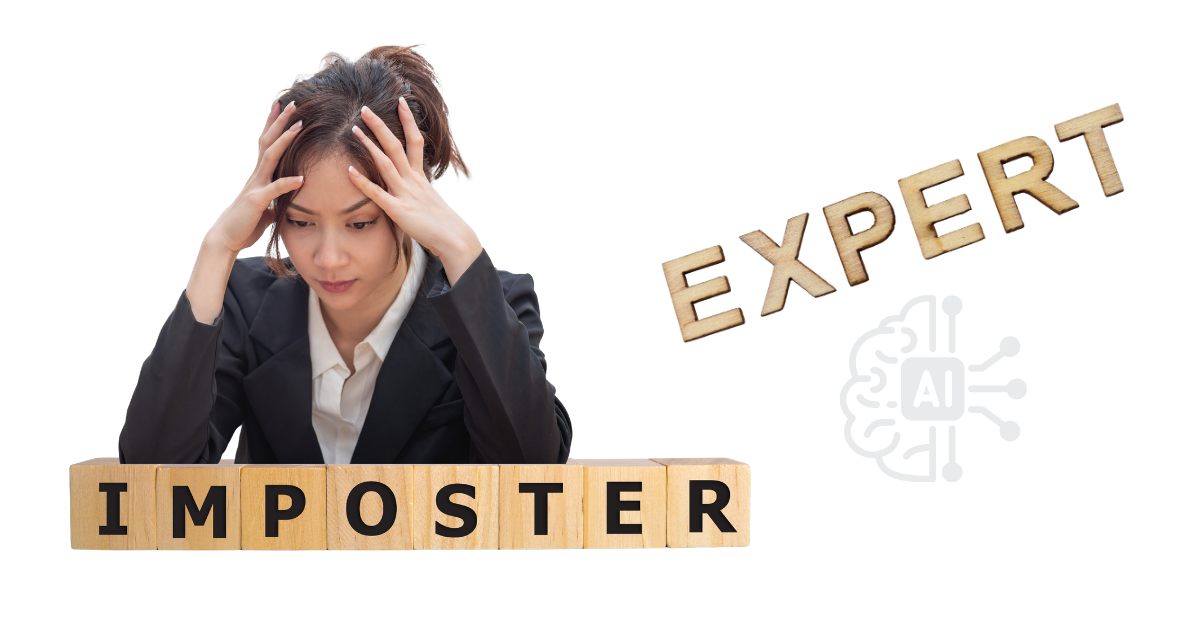
Recently, I was preparing an upcoming presentation on imposter syndrome. Because the world has changed considerably since I last delivered the program, I suggested we add a discussion about AI and its influence on those experiencing this phenomenon.
During our conversation, I mentioned something I had been noticing. People who run imposter syndrome patterns are already accustomed to wondering whether someone else could take their place. What if they find someone better? What if they realize I’m not as capable as they think I am? What if someone else can do this better than I can? AI gives that familiar internal conversation a new target:
What if AI can replace me?
The person coordinating the presentation shared that just that morning a woman in her organization, preparing for maternity leave, had expressed exactly that fear. Here was a woman stepping away from her role for a perfectly normal and temporary reason, yet the possibility of being replaced was present enough to be voiced. I don’t know whether she experiences imposter syndrome, and I wouldn’t presume to know that from a single comment. But the moment crystallized something I had been thinking about.
AI does not have to create an insecurity to amplify one.
That fear may be a perfectly logical, considered response to a legitimate external disruption. And you’re not wrong to see it that way.
AI is changing how we work, what we value and, in some cases, the very skills we spent years developing. There are legitimate reasons to wonder what our jobs will look like in five years, or even one.
But lately I’ve been thinking about this question through a different lens.
What happens when a very real external threat collides with an internal belief that was already there?
I know something about both sides of that collision.
I am the author of a book about imposter syndrome, The Imposter Lies Within, and a frequent speaker on the subject. I also lived with imposter syndrome for decades before I understood what was happening inside my own thinking. I know how convincingly it can distort the evidence in front of us. How accomplishment can be discounted, competence explained away and success attributed to luck, timing or simply working harder than everyone else.
I am also the founder and CEO of an AI company. I spend my days thinking about what this technology can do, where it is going and how it will change the way people work. I believe deeply in its potential. I am building for it.
I see these two worlds colliding, and I think we need to get ahead of it.
For someone whose internal programming has been telling them for years that they aren’t quite as capable as other people think they are, that they have somehow fooled everyone, or that eventually someone will figure out they don’t belong, AI introduces something new into that internal conversation.
Consider an attorney, for example. AI can write the brief, analyze the document, find the precedent and summarize the research. It will even draft the argument if given the chance. And it can do some of those things in seconds. Suddenly, the old fear has new evidence to work with. If AI can do what I do, what does that say about my value?
Being replaced is not a new fear for someone experiencing imposter syndrome. AI is simply a remarkably convincing new candidate for the replacement.
Not Every Fear About AI Is Imposter Syndrome
Before we go further, there is an important distinction to make. Worrying that AI could change your job, reduce the value of certain skills, or even eliminate your role is not imposter syndrome. Those concerns may be entirely rational. We are living through a period of significant technological disruption, and pretending otherwise doesn’t help anyone prepare for it.
Imposter syndrome is something different. It is not simply self-doubt, and it is not the occasional fear that you aren’t good enough. Most of us experience both. Imposter syndrome is a persistent pattern in which our perception of our own capability, worthiness or legitimacy is inconsistent with the evidence.[i]
At the heart of it is often the fear of being found out. That somehow we have convinced other people that we are more capable than we really are, and eventually someone is going to discover the truth.
Maya Angelou captured this beautifully. Despite having written eleven books, she described still thinking, “Uh oh, they’re going to find out now. I’ve run a game on everybody and they’re going to find me out.”[ii]
I often remind people that experiencing imposter syndrome doesn’t mean you are an imposter. It doesn’t mean anyone else thinks you’re an imposter. It means you think you’re an imposter.
That’s why I called my book The Imposter Lies Within. The imposter lies within, and it’s a liar. The evidence doesn’t support the belief.
I know that deceptive voice well because I lived with it for decades. The evidence that I was capable was there. The problem was that my internal narrative kept finding ways to discount it. Every accomplishment moved the goalpost rather than settling the question. There was always another level to reach, another person to compare myself to, another reason that what I had already done somehow didn’t quite count.
Comparison has always been fertile ground for imposter syndrome. We look at someone else’s expertise, confidence, success, title, education, creativity or ease and compare what we can see in them with everything we know about ourselves. We see their outside and compare it to our inside. It was already an uneven comparison. Now we have introduced an entirely new comparison target.
AI can process more information than we can. It can produce in seconds what might take us hours. It doesn’t get tired, have a bad day, or stare at a blank page wondering where to begin. And increasingly, it can perform tasks that many of us spent years learning to do well.
AI does not have to create an insecurity to amplify one.
For most of our lives, we compared ourselves with other humans who operated under roughly the same human constraints we did. Now we’re comparing ourselves with something that doesn’t share those constraints at all. That comparison isn’t just uneven. It may be impossible to win.
But perhaps winning is the wrong objective. There is a meaningful difference between recognizing that AI can perform parts of your work faster or better than you can and concluding that its capability says something about your capability.
AI may be able to do part of my job is an observation about the technology.
If AI can do this, maybe I’m not as valuable as I thought I was is an interpretation.
And for someone already carrying the fear that eventually they will be found out, AI can feel like something even more threatening.
What if AI is what finally finds me out?
The external threat may be real. The conclusion we draw about ourselves doesn’t automatically become true because of it.
Why AI Is Such a Powerful Trigger
AI may be particularly potent for people who experience imposter syndrome because it doesn’t simply tell us what it can do. It shows us.
We type a question and watch an answer appear. We upload a document and receive an analysis. We ask for code, an image, a presentation, a strategy or a first draft, and something that might have taken us hours, days or even years of accumulated expertise to produce appears in seconds.
That immediacy changes the nature of the comparison. It is one thing to know that someone, somewhere, may be better at something than we are. It is another to sit across from a technology and watch it perform a task we have spent years learning to do.
And we don’t tend to compare ourselves with AI in the areas where we have no expertise. We notice it most when it enters the territory we consider ours. The writer notices the writing. The attorney notices the legal analysis. The programmer notices the code.
That is where comparison can become something more than comparison. It can begin to challenge identity. Many of us have spent our careers accumulating signals that tell us, and other people, that we are competent. We have expertise that took years to develop. People come to us because we know what to do.
For someone experiencing imposter syndrome, those external signals can become particularly important because the internal belief has never quite caught up with the evidence. Then AI arrives and begins performing some of the very tasks we have been using as evidence that we belong.
The question can shift remarkably quickly from What can this technology do? to What does it mean that it can do something I thought made me valuable?
And I think we need to be careful here, because some of what people are experiencing is not distorted thinking. Expertise is being repriced. Some skills that once differentiated us may become widely accessible, and work that once required significant time or specialized knowledge may increasingly be augmented or automated. The value of certain capabilities will also change.[iii]
But there is another layer to this. We have a tendency to confuse what we do with who we are. If I have built my professional identity around being the person who knows, what happens when knowing is available to everyone? If my value has come from being the expert, what happens when expertise itself begins to look different?
For someone who already worries that their place isn’t quite secure, those aren’t merely questions about technology. They can feel like questions about worth. We are measuring ourselves against a system designed to do certain things humans cannot do at the same speed or scale, and then using the result of that comparison to make judgments about ourselves.
We don’t consider ourselves intellectually inadequate because a calculator can multiply faster than we can. We don’t question our physical worth because a forklift can lift more weight. Yet with AI, the boundary feels different because the capabilities being automated look remarkably similar to the ones we associate with intelligence, creativity and expertise.
That may be why this feels so personal. AI isn’t only changing what we can do, it is forcing us to examine why we believed doing those things made us valuable in the first place. That is what makes it feel like exposure. AI doesn’t know anything about us. But watching it do the work we built our identity around can feel like watching someone confirm what we were afraid was true all along.
The Same Technology, Different Internal Story
AI won’t trigger everyone in the same way. In The Imposter Lies Within, I describe seven archetypes, the behavioral patterns imposter syndrome tends to produce. I’ve seen them in the people I’ve worked with over the years, and I’ve lived several of them myself. We may share the underlying fear that we aren’t quite good enough, but we develop different ways of proving to ourselves and others that we are.
For some, it is perfection. For others, expertise, independence, natural ability, being agreeable, being needed or the capacity to do it all. AI can collide with each of those measures differently.
The Perfectionist sets extraordinarily high standards and tends to focus on what could have been better rather than what went well. AI can make that finish line even harder to reach. If a tool can revise, refine and generate another version in seconds, when is the work actually good enough? Instead of relieving the pressure to be perfect, AI can give the Perfectionist an almost endless ability to keep improving.
The Master believes competence means knowing. There is always another certification, another degree, another body of knowledge to acquire before they feel sufficiently qualified. Now they are working alongside technology with access to more information than any one person could possibly retain. If knowledge has been one of the ways they prove their value, AI can make them wonder what their years of expertise are worth.
The Prodigy has learned to associate competence with ease. If something comes naturally, they feel capable. If they have to struggle, ask questions or take time to learn it, they may interpret that struggle as evidence that they aren’t as smart as people think they are. AI is evolving so quickly that everyone is being asked to learn as we go. For the Prodigy, not immediately knowing how to use it can become its own imposter trigger.
The Lone Ranger believes they should be able to figure things out on their own. Asking for help risks exposing what they don’t know. But adapting to AI requires almost the opposite: experimentation, questions, collaboration and a willingness to admit that none of us has all of this figured out. The very behaviors that would help the Lone Ranger adapt may be the ones they have spent years avoiding.
The People Pleaser has trouble saying no. Setting a boundary feels risky, because being agreeable and available has quietly become part of how they earn their place. AI can take away one of the few boundaries they had left: time. When a request that once took a day can now be done in an hour, declining it becomes even harder to justify. Can you take a quick look? Can you just run it through the tool? So the People Pleaser says yes, and then yes again, until the capacity AI created has been given away one small favor at a time.
The Savior feels most worthy when they are needed. They are the one who rescues the struggling colleague, the stalled project, the deadline everyone else had written off. They measure their value by who and what they save. AI can quietly take some of those rescues away. When a tool can solve the problem at midnight, the Savior may feel less relief than loss. And when colleagues struggle to adapt, the Savior may rush in to carry that weight for them, taking on everyone else’s learning curve along with their own.
And then there is the Superhero, whose measure of competence is how much they can handle. They already expect themselves to do more, carry more and keep all of the balls in the air. AI might seem like the perfect solution, until increased efficiency becomes a reason to expect even more of themselves. If AI makes me faster, shouldn’t I be able to accomplish more? Suddenly, a technology designed in part to increase our capacity can become another way to raise the bar on ourselves.
The archetypes look different because the behaviors and internal rules are different. And one person can run multiple archetypal patterns. But underneath them, whether one, many or even all, is a remarkably similar equation: If I can be perfect enough, know enough, learn quickly enough, do enough on my own, please enough people, be needed enough or accomplish enough, then maybe I can finally prove that I belong here.
The problem is that the equation has no solution. There is always another mistake to avoid, something else to learn, someone else who makes it look easier, another person who seems more capable, another goal to achieve.
And now there is AI. A comparison target that can always know more, work faster and produce more. If we bring the same old measuring sticks into this new world, AI doesn’t just become another tool. It can become another way to prove to ourselves that we are falling short.
We have a tendency to confuse what we do with who we are.
Perhaps the real question isn’t how we measure up against AI. It’s why we are measuring our human value against it at all.
The Comparison We Were Never Going to Win
Human comparison was already uneven. AI takes that imbalance to an entirely different level. We are taking a system designed to process extraordinary amounts of information at extraordinary speed and placing its finished output next to the work of a single human being. Then, in some cases, we are using the difference to draw conclusions about our own intelligence, creativity or value.
The comparison itself is flawed. AI can produce an answer. But producing an answer is not the same thing as knowing whether it is the right answer. It can analyze enormous amounts of information, identify patterns and generate possibilities. But the response it gives us should not be the end of our thinking. It should become part of it.
We still have to question it. Does this make sense? What might be missing? What assumptions are embedded in the response? What happens if it’s wrong?
Challenging the response should be part of the process. That isn’t evidence that AI has failed. It is evidence that we are doing our job. Discernment is ours. Judgment is ours. And as AI becomes more capable, I would argue that both become more important, not less.
The attorney who receives a beautifully constructed legal argument still has to know whether the precedent applies. The physician looking at an AI-generated analysis still has to consider the patient sitting in front of them. The leader receiving a recommendation still has to understand the organization, the people affected, the tradeoffs and the consequences of acting on it.
AI can contribute extraordinary capability to each of those decisions. But capability does not eliminate the need for judgment. It raises the importance of knowing when and how to exercise it.
And here is where we have made the comparison too simplistic. We ask whether AI can perform a task a human performs and, when the answer is yes, we begin treating the human and the machine as interchangeable. But performing the task is not the same as carrying responsibility for the outcome.
We have spent a long time using productivity as a proxy for value. How much can you produce? How quickly? How efficiently can you solve the problem? AI is going to outperform us on many of those measures. In some cases, it already does.
But if our response is to run faster, produce more and know more in an attempt to prove that we still deserve our place, we may be reinforcing the very imposter pattern we need to examine.
Because that is what imposter syndrome has always asked us to do: Prove it.
Prove that you’re smart enough. Prove that you know enough. Prove that you work hard enough. Prove that you deserve to be here.
AI gives us a comparison we were never going to win. Which may force us to confront a much more important question: What if our value was never supposed to depend on winning the comparison?
Capability Is Not Identity
If AI activates an old imposter pattern, telling yourself not to feel threatened probably isn’t going to change much. The feeling is information. It tells us something has been activated. The question is what. What feels threatened? Where is comparison weighing in? What are you afraid this says about you?
For someone with imposter syndrome, that last question can be particularly revealing. Because the external event and the meaning we assign to it are not necessarily the same thing.
AI produced a better answer than I did. I’m not as smart as I thought I was.
Someone on my team is using AI more effectively than I am. I’m falling behind.
AI can now perform a task that took me years to master. My expertise doesn’t matter anymore.
My organization is automating part of my role. I’m replaceable.
The first statement in each of those examples may be true. The second is a conclusion. And conclusions can be challenged.
We should already be doing this with AI. A response can sound confident, polished and convincing and still deserve examination. We need to ask what it is based on, look for what might be missing, and challenge its assumptions. It is our responsibility to bring judgment and discernment to what we’ve been given.
Our internal narratives deserve the same scrutiny. What do I know is true? Not what am I afraid might be true. Not what does this moment seem to confirm. What does the evidence actually tell me?
That question creates space between the feeling and the conclusion. Maybe you do need to develop new skills. Maybe part of your role is going to change. Maybe someone else is further along in learning how to use AI. Maybe expertise that once differentiated you is becoming easier to access.
None of those realities automatically proves that you are inadequate, fraudulent or no longer valuable. That is mistaking capability for identity.
AI changes how work gets done. It may change which capabilities are valued and where our expertise is best applied. But its capability does not determine who you are or your value.
So instead of asking only, Can AI do what I do?, we can begin asking better questions. What is AI capable of here? What am I responsible for? What should I challenge rather than simply accept? And where do I need to learn, adapt or change?
That last question matters too. Reframing imposter thinking isn’t about reassuring ourselves that everything will remain the same. Sometimes the evidence will tell us that we need to change.
But there is an enormous difference between I need to adapt and I am not enough.
The first gives us something we can act on. The second turns a changing circumstance into a judgment about who we are. Perhaps learning to recognize the difference is one of the most important skills we can carry into an AI-shaped future.
What If AI Can Replace Me?
I began with this question because I think we’re going to hear it a lot more. For some people, the answer may be uncomfortable. AI will replace tasks. It will change roles. Some jobs will disappear while others are created. Skills we once considered highly valuable may become less so, and entirely new capabilities will become important.[iv] [v]
We shouldn’t minimize that reality. But What if AI can replace me? contains another question if we listen closely enough. What happens to my value if it can? That is the question I am more interested in.
Having lived with imposter syndrome for decades, I know how quickly uncertainty can become something much more personal. A change in circumstance becomes evidence that we aren’t good enough. Someone else’s success becomes evidence that we are falling behind. A gap in our knowledge becomes evidence that perhaps we never deserved to be in the room in the first place.
AI gives that voice an extraordinary amount of new material to work with. But we don’t have to believe everything it tells us. We are already learning not to accept what AI gives us simply because it sounds confident.
The voice inside our own heads can sound just as convincing. I’m falling behind. I’m not as capable as I thought I was. My expertise doesn’t matter anymore. I’m replaceable.
We need to challenge both. The work isn’t to convince ourselves that AI poses no threat. Nor is it to find a list of human capabilities we can declare permanently beyond its reach. The work is to see clearly.
So the questions become: What is actually changing? What remains my responsibility? And what am I making all of this mean about me that simply isn’t true?
I have spent much of my career helping people recognize the difference between the evidence in front of them and the internal story they have built around it. Now, as the founder of an AI company, I find myself looking at that same distinction through an entirely new lens.
AI is going to challenge many of our assumptions about work, expertise and capability. Maybe it should challenge one more: the idea that our value was ever determined by how well we could prove it.
AI may change what we do. It may change how we work. It may even force some of us to reconsider where and how we create value. But it doesn’t get to decide what we are worth.
The technology is new.
The fear is not.
Neither is the work of trusting ourselves.
About the Author
Sheryl Anjanette is the founder and CEO of Parsley360, an AI company focused on the human side of transformation. She is an author, speaker and behavioral expert whose work explores trust, human behavior and our evolving relationship with AI. The Future of Trust examines what happens to people, organizations and trust as technology changes the world around us.
[i] Prevalence, Predictors, and Treatment of Impostor Syndrome: a Systematic Review - PMC
[ii] 7 Informative Quotes on Impostor Syndrome | Grammarly
[iii] Generative AI and jobs: A 2025 update | International Labour Organization
[iv] Generative AI and jobs: A 2025 update | International Labour Organization
[v] Future of Jobs Report 2025: 78 Million New Job Opportunities by 2030 but Urgent Upskilling Needed to Prepare Workforces > Press releases | World Economic Forum
This topic really makes you think because technology is no longer just changing what we do — it’s starting to challenge how we prove who we are.
With AI able to imitate voices, faces, writing styles, and even create convincing digital identities, trust becomes much harder. At the same time, the solution can’t be giving companies or governments unlimited access to our personal information just to prove we’re real. AI-driven impersonation is already pushing identity systems toward stronger verification, which brings its own privacy and control questions.
That connects directly to what we discuss at The 99% Perspective around AI governance: Who controls the technology? Who controls our data? Who sets the rules? And what protections do ordinary people have?
Technology can evolve, but our identity should never become something we have to surrender in order to participate in society.