
This is Part 11 of The AI Reckoning: A Future of Trust Series

Imagine you have a nail in your foot.
It’s painful, so of course you take your pain medicine of choice. Relief.
A few days later, your foot becomes infected. Now you need an antibiotic. It does its job; the infection seems to be under control.
Now you are healing… or are you?
The nail is still there.
We get remarkably good at treating symptoms. A pill for an ill. We relieve the pain, treat the infection, and manage the damage, while the thing creating it remains.
I’ve used some version of this example for years because it’s absurdly obvious. Most of us don’t need to be taught the difference between treating symptoms and addressing what’s causing them. If there’s a nail in your foot, you take out the nail.
And yet, we do the organizational equivalent every day.
When people are showing signs of burnout, we offer wellness programs and resilience training. When employees aren’t adopting a new technology, we give them more training. When an AI system produces something we don’t want, we add another guardrail.
None of those responses is wrong. The person in pain needs relief. An infection needs treatment. The employee may need support, and the AI system may absolutely need the guardrail.
The problem begins when the treatment becomes our definition of the problem.
That’s where my nail analogy starts to break down. A nail is wonderfully simple. There is an identifiable object causing the damage. Find it, remove it, treat what it damaged, and the body can begin to heal. Organizations rarely give us anything that clean.
There may not be one thing to remove. Burnout may be connected to workload, staffing, leadership, technology, expectations, incentives, and a culture that says wellbeing matters while quietly rewarding the people who never stop working.
Low AI adoption may have very little to do with whether employees know how to use the technology. The tool may not fit the workflow. People may not trust its output. Their manager may not use it. Or employees may be wondering what happens to their jobs if the productivity gains leadership keeps promising actually materialize.
Which one is the nail?
Maybe none of them.
Maybe what we’re looking at isn’t a collection of individual problems at all. Maybe we’re looking at what the system, taken as a whole, is producing. We treat the symptom because the symptom is what we can see, measure, and act on this quarter. Meanwhile, the system stays intact, quietly producing the next one.
That raises a different question, and I think a more important one. What if we’re solving problems systematically without first understanding them systemically?
Seeing the Problem Before Solving It
The words sound almost interchangeable, but systematic and systemic thinking do very different work.
Being systematic is about how we solve a problem. We gather information, identify what needs to change, create a plan, assign responsibility, act, and measure the result. Organizations are generally very good at this. We have methodologies, dashboards, project plans, KPIs, owners, timelines, and no shortage of ways to organize ourselves around a problem once we’ve decided what the problem is.
Being systemic starts earlier. Before we decide how to solve something, we have to understand what we’re actually looking at. That’s where root cause becomes important. If engagement is falling, why? If people are burning out, what’s creating the pressure? If employees aren’t using a new technology, what’s getting in the way? The first answer may point us in the right direction, but it may not take us far enough.
A team may be burning out because they’re understaffed. That looks like the cause until we ask why they’re understaffed. Perhaps positions have been frozen because of a cost-reduction target, or people have left and haven’t been replaced. Keep looking and we may discover that the workload hasn’t changed even though the resources have. What appeared on the surface as a burnout problem has taken us somewhere else entirely.
Thinking systemically means looking beneath what is visible rather than stopping at the first plausible explanation.
Systems thinking widens the view further. It asks us to look not only at what’s underneath the problem, but at what’s around it.
How are workload, incentives, leadership behavior, technology, processes, trust, and culture interacting? What is reinforcing what? Is the same pattern showing up somewhere else? What happens to the rest of the system when we change one part of it?
Organizations aren’t machines where we can replace one faulty part and assume everything else will continue exactly as before. People respond. Managers adapt. Incentives change behavior. Trust can grow or erode. An intervention in one place can create an effect somewhere we weren’t looking.
We need root-cause analysis and the wider lens of systems thinking. Then we need to be systematic about what we do with what we’ve learned.
But getting to that understanding depends on something we often assume we already have: an accurate picture of what’s really happening, and that’s much harder than it sounds.
Why We Don’t See What’s Really Going On
The higher you move in an organization, the harder it can become to know what’s actually happening inside it. That sounds counterintuitive. Leaders have more information than almost anyone else. They have dashboards, surveys, financial reports, employee data, customer feedback, performance metrics, and teams whose job it is to keep them informed. But having more information isn’t necessarily the same as having greater visibility.
People edit what they say. Sometimes they do it because they’re afraid of the consequences. An employee who doesn’t trust their manager isn’t likely to say exactly what they think about a new initiative, a reorganization, or the way their team is being led. They learn what is safe to say, what should be softened, and what is better left unsaid.[i][ii]
Sometimes the filtering is less deliberate. A manager hears frustration from their team but doesn’t want to bring leadership another problem without a solution, so they translate it into something more actionable. Another manager believes the concern is temporary and decides not to escalate it. Someone farther up summarizes ten conversations into three bullet points for an executive meeting. At every step, the information may be accurate, but something can still get lost. By the time it reaches the people making decisions, the signal may look very different from where it started.
Organizational structure adds another challenge. HR sees engagement and turnover. IT sees technology usage. Operations sees productivity. Finance sees cost. Managers see what is happening on their teams. Each may hold a legitimate piece of the picture without anyone seeing how those pieces fit together.
Then there is the data itself. We can measure whether people are using a new AI tool. We can measure turnover, absenteeism, productivity, engagement scores, and any number of other outcomes. Those measures can tell us something important is happening. They don’t necessarily tell us why. Yet numbers have a way of feeling more definitive than the human information around them. If usage is low, we see an adoption problem. If engagement scores fall, we see an engagement problem. If productivity drops, we see a performance problem. Once we’ve named the problem, we begin looking for evidence and solutions that fit the name we’ve given it. The label itself can narrow what we’re willing to see.
There is another layer that is harder to talk about. People naturally protect the things they are invested in. A leader who championed a transformation may be more inclined to see resistance from employees than flaws in the transformation itself. A manager whose team is struggling may see a resource problem before considering whether their own leadership is contributing to it. An executive who made a difficult decision may genuinely believe the problem is in the execution rather than the decision.
None of this requires bad intentions. Some of the filtering happens precisely because people are trying to do their jobs well, protect their teams, support a decision, or avoid creating unnecessary friction. But good intentions don’t guarantee good information.
Underneath all of this is trust.
If people don’t believe they can tell the truth without paying a price for it, the organization loses access to information it may not be able to get any other way.[iii] A survey can tell you that trust is low, but it can’t tell you what someone would say about their manager if they knew their manager would never hear it. A dashboard can tell you that adoption is lagging, but it can’t tell you that employees understand the technology perfectly well but are afraid of what successful adoption might eventually mean for their jobs.
This creates a difficult loop. The less people trust the organization, the less likely they are to say what they’re really experiencing. The less leadership hears, the harder it becomes to understand what’s actually happening.
Decisions are then made from an incomplete picture, and if those decisions miss what people are experiencing, trust can erode further. Leaders may respond by asking for more information. Another survey. Another dashboard. Another metric. Better analytics. Those things can help. But more data doesn’t necessarily reveal what people don’t feel safe enough to say. And if we can’t see what’s really happening beneath the surface, even the most disciplined problem-solving process can lead us somewhere we didn’t intend to go.
When the Solution Changes the System
Once we understand the problem, the next instinct is to fix it. That’s exactly what we should do. Understanding what created the problem, though, is only part of the work. We also need to understand what happens when we introduce a solution.
An intervention doesn’t enter an organization in isolation. People respond to it. They interpret what it means. They adjust their behavior. It can change incentives, relationships, workload, trust, and sometimes the very conditions we were trying to improve.
AI adoption is a good example.
Imagine an organization has invested heavily in new AI tools, but usage is well below expectations. Leadership sees the numbers and responds. Employees get more training. Managers are given adoption targets. Usage becomes part of team conversations. Perhaps dashboards are introduced so leaders can see where the technology is and isn’t being used.
The numbers begin to rise. It looks like the intervention worked. But what exactly went up? Employees may be using the technology because they understand its value, trust the direction the organization is taking, and have found meaningful ways to incorporate it into their work. Or they may be using it because their manager expects them to and they know someone is watching the numbers. The dashboard may record both as adoption. Only one of them is. The other is compliance.
In the short term, they can look remarkably similar. Over time, they can lead somewhere very different. If the reason people weren’t using the technology in the first place was lack of training, then more training may have addressed exactly what was needed. But what if training was never the real issue? What if people were concerned about the accuracy of the tool, unsure how it fit into their work, or worried about what the promised productivity gains might eventually mean for their jobs?[iv]
Now the intervention is acting on something other than the condition that produced the behavior. Usage may increase, but the uncertainty hasn’t gone away. If employees feel pressured or monitored, trust may decline further. People may become less willing to voice concerns because they’ve learned that the organization has already decided what the desired behavior is. Managers see the improving numbers and report that adoption is going well. Leadership receives confirmation that the intervention worked.
The original problem hasn’t necessarily been solved. It may simply have become harder to see. This is where looking upstream and downstream becomes important. Upstream are the conditions that helped produce what we’re seeing in the first place: trust, belonging, leadership behavior, incentives, workload, fear, the way decisions are communicated, whether people believe they have a voice in changes that affect them.
An intervention in one place can create an effect somewhere we weren’t looking.
Downstream is what happens after we intervene. How do people respond? What behaviors change? What happens to trust or belonging? Does the solution create more work somewhere else? Does it solve a problem for one group while creating one for another? What happens six months later, after the initial pressure, attention, or incentive is gone? Those effects won’t necessarily show up in the metric we were trying to improve. Turnover can drop after retention bonuses are introduced, but that doesn’t tell us whether people actually want to stay or whether we’ve simply made leaving more expensive. A team can produce more with fewer people while employees work longer hours and absorb a workload that eventually shows up as burnout or attrition. Engagement scores can improve after managers are held accountable for them while employees become more careful about how they respond.
The metric isn’t wrong. It’s measuring what we asked it to measure. The question is what we’re allowing that number to tell us.
Those measures can tell us something important is happening. They don’t necessarily tell us why.
People also respond to being measured. Managers focus attention on the numbers they’re accountable for. Employees learn which behaviors matter. Teams adapt to the targets placed in front of them. It’s the organizational version of Goodhart’s Law: when a measure becomes a target, it can stop being a reliable measure of what we actually care about.[v] Measurement can focus attention and help change behavior. But behavior changing and the underlying condition changing are not always the same thing.[vi]
The numbers can improve while something underneath them gets worse. And those effects don’t necessarily stay where the intervention happened. Increased productivity can eventually show up as burnout, absenteeism, or turnover. Pressure to improve engagement scores can make people less candid, giving leaders an even less accurate picture of what employees are experiencing. Those consequences can eventually become the next set of symptoms the organization tries to solve.
When the System Feeds Itself
The effects inside a system don’t always move in one direction. What happens downstream can eventually circle back and change the conditions that contributed to the problem in the first place. Consider an understaffed team. There aren’t enough people to handle the workload, so everyone pushes harder. They work longer hours, take on more responsibility, and find ways to get more done with less. Productivity holds, and perhaps even improves.
From the outside, the team may look like it’s managing remarkably well, but the increased effort can mask the staffing problem. If the work is still getting done, there is less urgency to add resources. Over time, the people carrying the extra load become exhausted. Some disengage, others leave. Now the team is even more understaffed, and the people who remain have to absorb even more. What began as a staffing problem has created conditions that make the staffing problem worse.
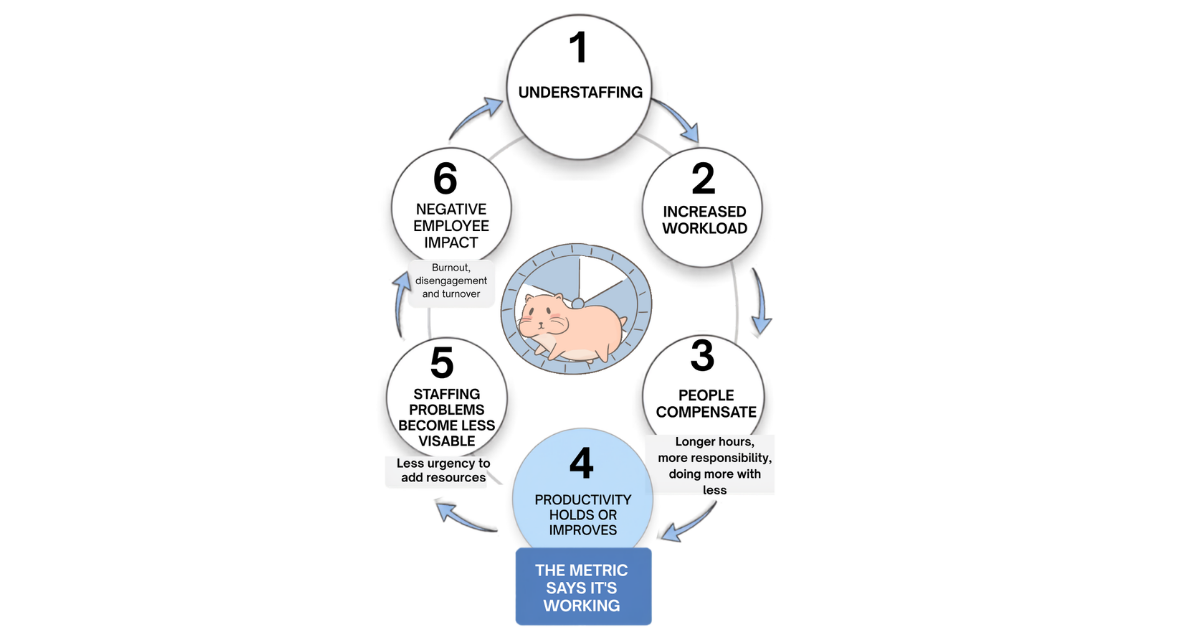
Belonging can work the same way, although it’s much harder to see. Someone who doesn’t feel that they belong may begin participating less. They speak up less often in meetings, stop volunteering ideas, or withdraw from some of the informal interactions where relationships are built. Their colleagues may interpret that behavior as disinterest and begin including them less often. No one has necessarily done anything intentionally wrong. But the person feels increasingly outside the group, which leads to more withdrawal and less connection. By then, what started as an effect has become part of what is causing the problem.
Those consequences can eventually become the next set of symptoms the organization tries to solve.
These patterns are difficult to see when we’re looking at a snapshot. Productivity is holding. The work is getting done. The employee isn’t complaining. The meeting seems fine. The system is still moving underneath what we can see. Once a pattern begins reinforcing itself, solving the most visible symptom may do very little to interrupt it. We need to understand not only what produced the outcome, but what is now keeping it in place.
AI Raises the Stakes
Now this is where the AI reckoning comes in. AI changes this equation because it gives us an extraordinary ability to solve the problems we put in front of it. We can analyze more information, find patterns we might otherwise miss, predict outcomes, identify anomalies, optimize processes, and make decisions faster than we could before. As these systems become more capable, that ability will only increase.
But AI is still working with the problem we give it. If we ask how to increase productivity, it can help us find ways to increase productivity. If we ask how to improve adoption, it can identify behaviors associated with higher usage. If we ask how to reduce turnover, it can find patterns among the people who stay and the people who leave.
What it may not tell us is whether productivity, adoption, or turnover is the problem we should be solving. How we’ve framed the question and the prompt, what data is available, and what we’re measuring all influence the recommendations. Then there is what the system cannot see. If employees aren’t telling us what they really think, AI doesn’t magically recover what was never captured. If different parts of the organization hold different pieces of the problem, analyzing one data set more deeply may give us greater confidence without giving us a more complete picture.
In some ways, AI could make this easier to miss.
The analysis gets better, the predictions become more precise, the recommendations arrive faster, and we have more evidence to support the course we’ve chosen. All of that can make a decision feel increasingly well informed, even when the original frame is incomplete.
Let’s go back to the example of the understaffed team. If productivity remains strong, an AI system looking at output, workload, and staffing costs might reasonably conclude that the team is operating efficiently. It might even identify opportunities to increase efficiency further. What it may not see is how much extra effort people are expending to keep those numbers where they are, who is quietly looking for another job, which manager is absorbing work late at night, or how close the team is to the point where the pattern stops being sustainable. It’s possible that some of that information exists somewhere, while likely that much of it does not.
This is where human judgment becomes more important than ever. Someone needs to question what the system is optimizing for, what information it has, what information it doesn’t have, and whether the problem presented to it reflects what’s actually happening.
The risk isn’t simply that AI will give us a bad answer. It’s that it gives us an excellent answer to the wrong question. And because we can now act on that answer faster, more consistently, and at greater scale, the consequences of getting the question wrong become larger too.
AI can make us far more systematic in how we solve problems, something we were already pretty good at. The bigger question is whether it can also help us see those problems systemically, or whether that still depends on us.
Seeing Systemically, Acting Systematically
This is not an argument for waiting until we understand every variable before we act. In complex organizations, we rarely will, nor should we. People still need support. Problems still need attention. Decisions still have to be made. The difference is what happens before we decide what to do.
When something isn’t working, our first question is often some version of, “How do we fix it?” That’s a useful question, but it assumes we already understand what “it” is. We may need to stay with the problem a little longer. If engagement is falling, what are people actually experiencing? If adoption is low, what is getting in the way? If productivity has increased, what changed to produce it? If people aren’t speaking up, is there genuinely less to say, or have they decided it isn’t worth saying?
Next we need to look beyond the place where the problem first appeared. Who else sees a piece of this? What happened upstream? Where else is the pattern showing up? What are our incentives encouraging? What does the data tell us, and what might it be missing? What could be happening that we don’t have metrics for?
Some of the most important information may come from the places where we have the least visibility. Leaders need more than data. They need ways for people to tell them what they’re actually experiencing, particularly when that information is difficult to hear or difficult to measure.
That brings us back to trust.
If employees believe there is a cost to being candid, asking better questions won’t necessarily produce better answers. People need to believe they can say that the new technology isn’t helping, that the workload isn’t sustainable, that they don’t understand a decision, or that something a leader is doing is contributing to the problem without being labeled resistant, negative, or difficult. That kind of candor doesn’t happen through another survey. People pay attention to what happens when someone tells the truth, and they make their own judgments about what is safe to say.
Once we have a better understanding not just of what’s happening, but why, systematic thinking becomes essential. We still need a plan, and someone has to own it. We need to decide what to change, how we’ll change it, what we’ll measure, and how we’ll know whether it’s working.
But the measurement has to extend beyond the symptom that first got our attention. If usage rises, is it adoption or compliance? If productivity improves, what is happening to workload and burnout? If turnover falls, has the experience of working there changed? After the intervention has been in place for a while, what else changed that we didn’t expect?
We aren’t going to anticipate every consequence. Systems are too complex for that. But we can keep looking. It’s ongoing. An intervention isn’t necessarily the end of the problem-solving process. It can also give us new information about the system. We act, watch what happens, listen, and question our assumptions. When the system responds differently than we expected, we don’t force the evidence back into the story we started with. We reconsider the story.
Seeing systemically doesn’t replace systematic action. It gives us a better chance of acting on the problem we actually have.
Back to the Nail
The nail in the foot is easy because we know what we’re looking for. We can see the injury, find what’s causing it, remove the nail, and treat the damage. The problem and its cause are close enough together that the connection is hard to miss.
Organizations don’t usually make it that easy. What we see first may be several steps removed from what’s producing it. The cause may sit somewhere else in the organization, or several conditions may be interacting at once. The information we need may be divided across functions, buried in data that tells us what but not why, or held by people who have good reasons for keeping some of what they know to themselves.
Once we have a better understanding not just of what’s happening, but why, systematic thinking becomes essential.
Even when we understand enough to act, our solution enters a system that doesn’t stand still. Organizations are dynamic. People respond. Behavior changes. New effects emerge. Some of them may eventually reinforce the conditions we were trying to change. This doesn’t mean we should stop treating symptoms. The person with the nail in their foot still needs something for the pain. If there’s an infection, they still need the antibiotic.
But we can’t stop there. We have to get better at looking beneath what is visible, understanding what is connected, and paying attention to what happens after we intervene. Then we can bring all of our systematic discipline to solving the problem we’ve actually found.
This has always been important. I believe AI makes it more urgent. We are entering a period in which our ability to analyze, optimize, predict, and act will continue to accelerate. We will be able to solve more problems, more quickly, and with more precision than ever before. Which makes it increasingly important that we understand what we’re solving.
And that leaves us with a harder question.
What if the things leaders most need to understand are the very things they have the hardest time seeing?
Throughout The AI Reckoning, we’ve looked at what happens as intelligence becomes more powerful, more pervasive, and increasingly embedded in the decisions we make. In the final article of this series, I will bring those threads together and look at what I believe we need next.
Read more from The AI Reckoning: A Future of Trust Series
Part 1: The Hidden Cost of Intelligence, The Trust Story Hiding in Plain Sight
Part 2: The Reckoning Behind the Revenue: When the Numbers Don’t Add Up
Part 3: Rented Intelligence: Building on Borrowed Ground
Part 4: The Fragmentation Tax: Death by a Thousand Tools
Part 5: The Human Adoption Gap: We Built the Technology, We Forgot the Human
Part 6: Signal, Noise, and Judgment: The Trust Debt Nobody Is Measuring
Part 7: The Generation Saying No: Is Anyone Listening?
Part 8: When Seeing Is No Longer Believing: Trust Under Attack
Part 9: The Room Where Everyone Agrees With You
Part 10: The Black Box Problem: Why Explainability Is the Foundation of Trust
[i] Silenced by fear:: The nature, sources, and consequences of fear at work - ScienceDirect
[ii] Psychological safety: A systematic review of the literature - ScienceDirect
[iii] Edmondson, A. C. (1999). “Psychological Safety and Learning Behavior in Work Teams.” Administrative Science Quarterly, 44(2), 350–383
[iv] On Future AI Use in Workplace, US Workers More Worried Than Hopeful | Pew Research Center
[v] Signaling and meaning in organizational analytics: coping with Goodhart’s Law in an era of digitization and datafication - PMC
[vi] Building less-flawed metrics: Understanding and creating better measurement and incentive systems - PMC
Sheryl, seeing this as Part 11 makes me curious to go back through the rest of the series! The idea that AI can make us much better at solving the wrong problem feels especially important. More capability can amplify a weak problem frame just as easily as a good one. Looking forward to seeing how you bring the series together.